• NoodiMag Volume 6

    Welcome to NoodiMag, the container for all my noodling on noodles, pastas, and all related topics. It has been over three weeks since the last one instead of the usual two, which I’m sure everyone noticed. Thank you for your patience. I think this one will be worth the wait.

    Pasta Shapes Consumed: Penne Rigate; Chifferi Rigate; Miniature Shells; Macaroni; “No Yolks” Whole Wheat Egg Noodles Extra Broad;

    Total Pasta Shapes To Date: 18

    The Appetizer

    Today I reveal accomplices in this journey. Firstly, LS is my main companion in eating lots of pastas. Wondering to each other if certain dishes count, getting pictures of her pasta hauls from the grocery, and updating our stats has been a delightful throughline of my year so far.
    For NoodiMag, KD has been giving feedback, offering edits, and all around aiding and abetting what I’ve been up to here. I’m very grateful, and we all have her to thank for this issue’s issue.
    Then there’s KL, who heard about this issue’s issue and immediately jumped in with more ideas and musings about this issue’s issue.
    I also have to give credit to QH, who heard I was looking for a lesser known 14th Century Italian work of fiction and immediately pulled it off his shelf and found the passage I needed.
    And at the eleventh hour, my dearest one, ML, contributed a fabulous idea that really pulls it all together.
    If I may offer a bit of non-pasta advice for this issue’s appetizer: surround yourself with enthusiastic people. Everything you do will be better with them. 

    The Entree:

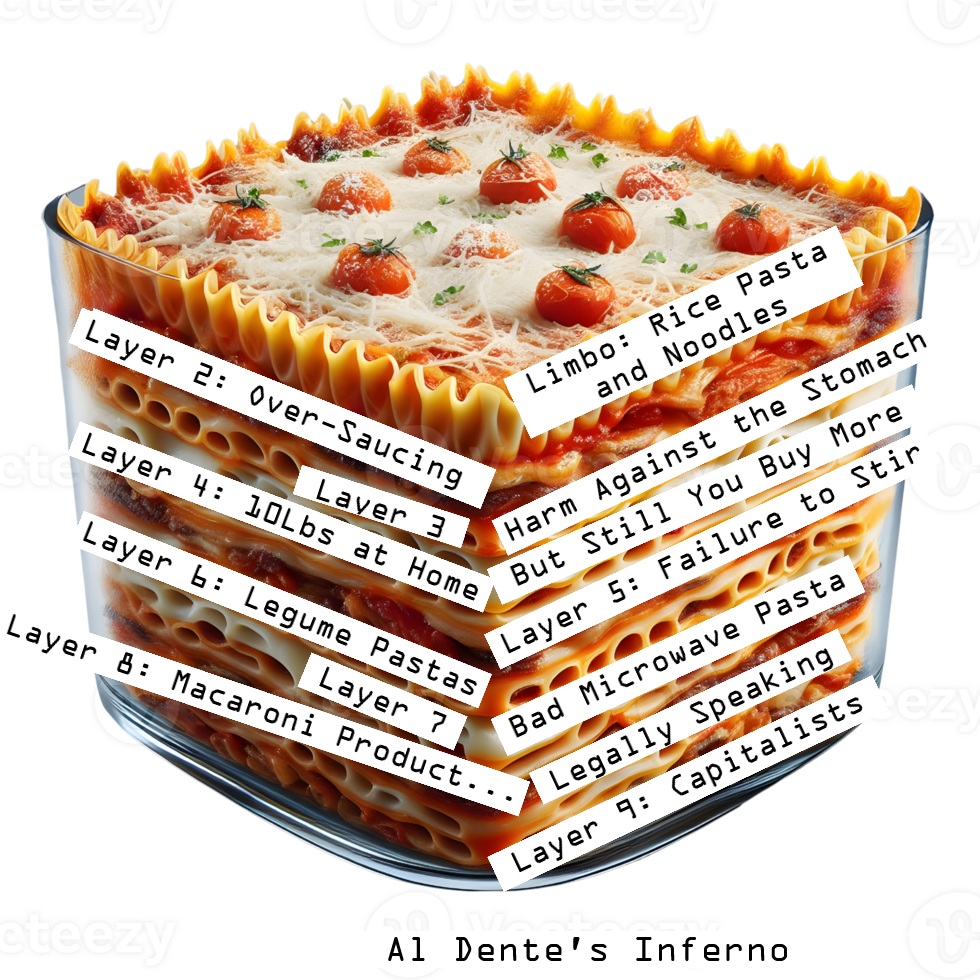
    At issue in this issue is the Nine Circles of Al Dente’s Inferno, otherwise known as Pasta Hell. KD, KL, QH, ML and I put our heads and hearts together and determined what pasta sins would land you in each circle. None of us believe in hell or sin in the Christian sense, but we do believe in thought experiments. We tried our best to follow Dante’s logic and apply pasta sins accordingly. I also have never actually read Dante’s Inferno; I have only seen the Mudde Show at the Ohio Renaissance Festival parody it, but I feel like I get the idea. 

    Circle One: Rice Pastas and Noodles

    The first circle of Hell in Dante’s Inferno is Limbo. This is where the “virtuous non-Christians” go. These are the folks who didn’t do anything wrong except for not accepting Jesus into their hearts. In Dante’s mind, all the people who just sort of have their own thing going besides Christianity go here, which is most of us. At least we all still get to hang out. 🙂
    We put rice pastas and noodles here as “virtuous non-pastas.” They haven’t done anything wrong except not accepting semolina into their hearts. Some of them are getting along well with pastas. Some can even be successful stand-ins for pasta! Many, many more are not even trying to be pasta. They’ve got their own thing going. They don’t need semolina to successfully move through their little existence. They’re not being tormented, but neither are they in heaven, which I don’t think they really care about anyways.

    Circle Two: Over-Saucing

    In the Second Circle, the lustful, those who let their desires sway their reason, are blown about by powerful winds, the way their wantonness metaphorically blew them about in life. It seems one of the defining features of lust versus the sins to come is that it is a mutual over-indulgence between two beings, and a lack of accountability or acknowledgement for it.
    You over-saucers and your over-sauced noodles are going here. You who let your saucy desires overtake you and ruin a nice pasta dish will blow about for all eternity. Your noodles absolutely dripping in beautiful and wasted sauce will blow about with you, hopefully slapping you in the face. You’ve made a saucy mess in life and in Hell, and you can’t blame it on anyone else.

    Circle Three: Harm Against the Stomach

    Circle Three is for the gluttonous, those who engage in solitary over-indulgence. They thrash about in icy muck and mire, and are regularly clawed by Cerberus, the three-headed beast.
    I will pass through here on my way to a worse part of Pasta Hell, for I have committed harm against the stomach. I have at times eaten way too much pasta in one go, or eaten it for too many meals in a row, to the point where I no longer enjoy it and, in fact, develop a tummy ache. This is sin against myself and against the pasta, for the point of it is enjoyment. I think perhaps the punishment in this circle does not fit the crime, but this is Dante’s Inferno and we’re just playing in it. 

    Circle Four: 10 Pounds At Home, But Still You Buy More

    Circle Four is inhabited by the greedy. It is guarded by the classical deity of wealth, who says an apparently very scary cryptic phrase to Dante, and is home to an eternally raging battle between those who hoard wealth and those who waste it. It sounds like they sort of just roll large boulders at each other and yell, “Why do you hoard?” and “Why do you waste?” They are experiencing for all eternity the mutual aggression they perceived in life, and the harm that comes of it. A key piece of this sin is the perception of peers and community as competition for resources, resulting in animosity against them. They lose themselves in the battle, seeing and doing and being nothing else.
    This is where LS and I are going for all eternity. We are hoarders of pasta. I have been honest about how many pounds I have stashed away in my pantry, and about continuing to buy more in spite of this. Listen, if I encounter a shape you don’t see very often, I’m buying it. There’s only so much of it, and I have to be one of the people who has it. And I won’t touch it for months. I just gotta have it. My lack of remorse about this is why I’ll be shoving, I guess, giant meatballs (?) at those who wasted pasta for all eternity. 

    Circle Five: Failure to Stir

    In Circle Five, the wrathful are punished in the yucky waters of the River Styx. I see that the waters are supposed to be swampy, but I will not have any swamp slander on my blog so… for our purposes it’s just a gross, polluted river, okay? Anyways, the actively wrathful wrastle each other forever on the surface of the water. The passively wrathful wallow beneath the surface, choking on their unexpressed rage. Yeesh.
    This state of affairs makes me think of what happens when one fails to mind their pot of boiling pasta. That “stir occasionally” direction is actually so fucking important. When you don’t, your actively rageful salted, starchy water bubbles over the top and makes a whole mess of your stove! And your sullen little pastas sink, sticking to the bottom of the pot! You’ve ruined it! You’re angry. I’m angry. We deserve our fate. We’ve wasted perfectly good pasta.
    If I seem a little worked up about this, it’s because I did a minor version of exactly this earlier this week, and have not come to terms with it yet. I don’t know how the Inferno works when you’ve racked up multiple sins, but I know I gotta visit Circle Five for a time-out from slinging meatballs.

    Circle Six: Legume Pastas

    The throughline of Circles Two through Five is over-indulgence in passion, letting our good sense be overcome by desire, fear, and anger. They’re bad, but not, like, so bad compared to what’s to come.
    In Circle Six we move to sins of betrayal, of intentional wrongdoing. Circle Six punishes heretics by trapping them in flaming tombs. Heresy is when one knows and understands the doctrine of the Church, the conventions of their community, and still consciously goes against them. Dante seems to really hate the Epicurans in particular, but it seems the main issue he has with Epicurus and his followers is that they do not believe in the immortality of the soul. The other issue he takes with heretics is that they create division in the community. I am holding my tongue about how sometimes a community needs to be divided because the doctrine sucks!! Anyways, I think it’s cute that he just fucking hates this philosopher and these Florentine politicians who didn’t believe in the immortality of the soul, so he’s like, “I’m gonna write a story where their immortal souls are tortured, hehehe.”
    Okay, anyways, fuck legume pastas. They know pasta and noodle doctrine. They understand it. And yet they actively go against it. They stand there in the pasta aisle, bragging about protein content, having terrible texture, having the fucking gall to call themselves both legume and pasta when they are an embarrassment to both. They exist only as a mockery. They deserve what they get. Let them burn forever.

    Circle Seven: Bad Microwave Pasta

    To visit the Seventh Circle, you have to outrun the Minotaur!! Ahh!! Shit gets so Metal from here on out. Here there are three rings, and depending on who or what you did violence against, you get to do one of the following: be submersed in boiling blood forever, the depth of which depends on the level of violence, and be shot by centaurs if you try to rise out of it; be transformed into a gnarled, withered tree and attacked by Harpies for all time; or be cast out to a scorched desert where fire rains down and you must lie supine, run in circles, or stand crouched and weeping, depending on your crime. It feels significant that Dante runs into some guys he admires in this Circle.
    And so this is where Bad Microwave Pastas are doomed to spend eternity. They are a sin against neighbors, the self, and G-d, Art, and Nature all rolled into one. I like some of them!! But I know they are sin. I wrote in the last issue about microwave pasta and how it is evidence of how far we have strayed from G-d. I summed it up like this:
    “We have fed the masses, but they have not been enriched. Not like the macaroni products they are sold for profit. My microwave pasta meal comes to me through imperialism and capitalism. It comes to me at no small expense to the earth, the workers, and our full experience of the fullness of the world. It is convenient. It is fast. It is tasty enough. But is that worth the true cost?”
    There is, of course, a gradient to just how sinful they are. Store-brand knockoffs of Chef Boyardee deserve the Plain of Burning Sand, for instance. Lean Cuisine pastas ought to be attacked by Harpies, while your Amy’s and your Rao’s can just boil in blood. 

    Circle Eight: Macaroni Product, Legally Speaking

    I simply cannot get into all the details of what is going on in these Evil Ditches in Circle Eight. There is so much happening here and so many specific sins mentioned and so many specific punishments described. We’ve got ten layers of evil ditches descending downward into a central well. We’ve got people steeping in excrement, people with their heads turned around backwards, farting demons, really mean lizards, people carrying their own severed heads, lots of fire and disease, and much more. It’s pretty gross in there, but that’s what you get for doing one of the many kinds of fraud and corruption and taking advantage of other peoples’ sins that get them into the upper half of Hell for your own advantage!! (I am reserving my commentary about Muhammad and Ali being here! One of many things I’ll need to speak to Dante about in Hell!)
    Anyways, the worst kind of sinful pasta fraud we can imagine is those purveyors of macaroni products that only fit that description in a legal sense. What I mean is, there is a minimum amount of semolina flour that must be present in order for a food to be legally considered a macaroni product, and some companies will just barely meet that requirement, and mix in other cheaper, subpar flours in order to save themselves a buck. It’s blasphemous and it’s deceitful. At least with the legume pastas, they’re forward about giving you a subpar product. These people, they take advantage of your need to live frugally, they lie to you, and they take your money in exchange for GARBAGE. Fuck these guys. Give them to the shit and the farting demons. Let the snakes snap at their necks. I don’t care which evil ditch you put them in, just GET ‘EM!! 

    Circle Nine: Capitalists

    Ah, the deepest layer of hell. The frozen lake to which traitors to G-d and humanity are doomed to spend eternity, far from reaches of the sun’s loving rays. And this is where we place the capitalists who commercialized, mechanized,  industrialized, and automatized pasta production. All the fuckers I read about in Macaroni Journal, the defunct trade magazine for the National Pasta Association, formerly known as the National Macaroni Manufacturer’s Association? Yeah, they’re all there frozen up to their necks, either able or unable to bow their heads to avoid the howling winds, depending, or frozen in supine position with their tear ducts frozen, preventing them even the comfort of tears, or frozen completely, contorted into horrible shapes, just like their souls. The guys who started the pasta-maker guilds in medieval Italy and didn’t let women in, despite them being the original experts in the craft? Oh, yeah, they’re there. The guy who owned the Torre Annunziata factory and called out the military on his rioting workers? You bet he’s there! The people who invented the machines that allowed for hands-free continuous production? Oh boy!! It’s crowded down here, and they all deserve it for their betrayal of kin, community, and all those who trusted and relied upon them.

    In the Center of Hell, the Devil stands, three-headed, with one of the worst traitors of all (to Dante) dangling from each mouth: The two guys who betrayed Ceasar and, of course, that classic worst guy ever… Judas!!!
    Please enjoy this illustration of which pasta sinners I would put in each of the Devil’s mouths.
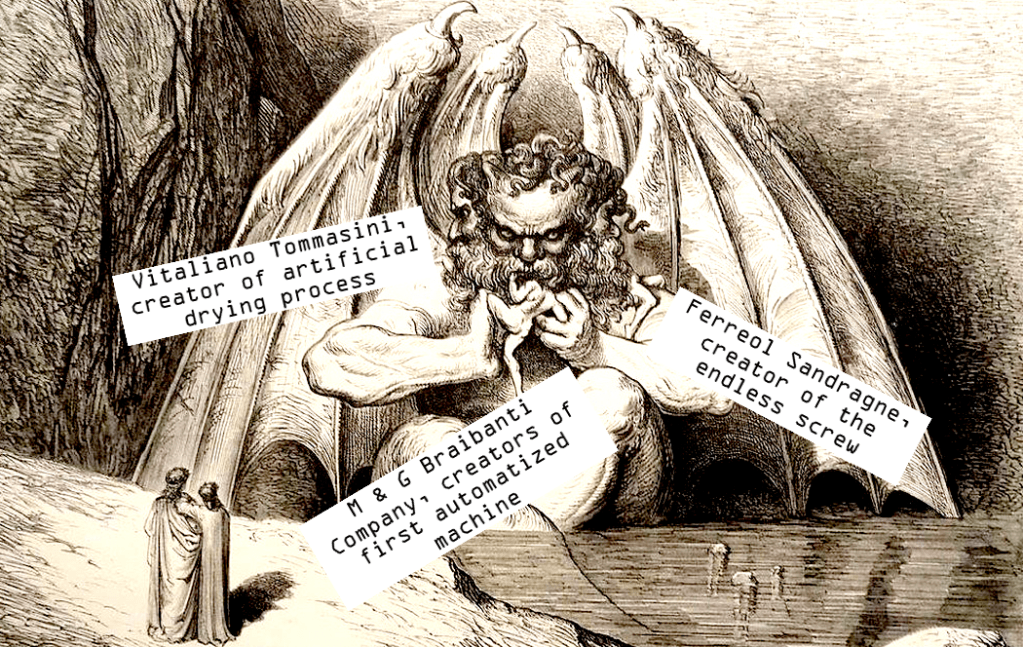

    Irrelevant to pasta, it just feels so important that at the end of the Inferno, Dante and Virgil arrive at the Devil’s genitals and pass through the Center of the Universe (!!!) before reemerging in the Southern Hemisphere, saying some really incorrect geography stuff, and then arriving home just in time for Easter morning. 🙂 Wow. What a journey. 

    If you need help keeping track of your pasta sins and where you’ll end up as a result, please enjoy this handy diagram:
    The Dessert:

    If I were to believe in a heaven, it would be a paradise described in another 14th Century work of fiction. It is but a miniscule fraction of the larger text, but it is perhaps the best known passage of the Decameron:

    “Maso replied that they occurred in Nomansland, a country of the Baschi, in a district which is called Bengodi, where they tie the vines with sausages and you can buy a goose for a cent and have the gosling with it. Moreover, in that country there was a mountain of grated Parmesan cheese, inhabited by people who did nothing but make macaroni and ravioli, which they cooked in chicken broth and then threw on the ground, and those who can pick up most get most. Nearby there was a stream of white wine, the best ever drunk, without a drop of water in it.
    ‘Oh,’ said Calandrino, ‘that sounds a great country. But what do they do with all the chickens they cook?’
    ‘All the Baschi eat them,’ replied Maso.
    ‘Were you ever there?’ asked Calandrino.
    ‘Was I ever there?’ said Maso. ‘I’ve been there thousands of times.’
    ‘How many miles away is it?’ asked Calandrino.
    ‘More than a thousand, going night and day,’ replied Maso.
    ‘It must be further off than the Abruzzi,’ said Calandrino.
    ‘Ah! indeed,’ replied Maso, “that it is.”
    The simple-minded Calandrino, observing that Maso made these remarks with a sober face and without laughing, believed them as the most manifest truth…” 

    Maso belongs in some circle of Hell for taking advantage of the gullible, “simple-minded” Calandrino for his own amusement, but we have got to give him credit for creativity. I’ll shake his hand when I see him, right before I slap him.

    Thank you for reading! Maybe next time will be better.

  • NoodiMag Volume 5

    Welcome to NoodiMag, the container for all my noodling on noodles, pastas, and all related topics.

    Pasta Shapes Consumed: Ditalini; Rotini; Elbow Macaroni; Miniature Shells; Penne Rigate; Tortellini

    Total Pasta Shapes To Date: 16

    The Appetizer:

    I am often thinking about how far we have strayed from G-d. Or perhaps how far we have strayed from the true nature of things, from our true nature. What is our true nature? Does a Thing remain that Thing as it transforms over time? At what point has some Thing changed enough that it becomes some Thing else?
    Obviously what I mean is: how confused and horrified would a medieval peasant from what we now call Italy be if they were transported to the room where I take my breaks from work and saw me microwaving some frozen pasta for dinner? Would the final product be even remotely recognizable to them as pasta, or, more accurately to their period, lasagne or vermicelli or macaroni or whatever other current local term they’re familiar with?
    Certainly the processes by which it got to me would be unrecognizable. To them, pasta (or lasagne or vermicelli or macaroni…) is something mixed by hand (or foot…), shaped by hand, dried in the sun over several days, cooked with boiling water, and tossed with whatever oils and dairy and meats and vegetables are available locally.
    They don’t even know about tomatoes or crushed red pepper or vodka. Penne did not exist yet, as mechanical extruders had not yet been invented. So my penne alla vodka, for instance, is entirely unfathomable to them. Never mind that the fact of it being mass produced, frozen, shipped across the globe, and then cooked in a microwave is beyond comprehension in a way that a new species of plant or a new fermented beverage is not.
    I know that, fundamentally, at its core, it is technically the same Thing. But it feels meaningful that it is also so fundamentally different. I would rather be eating the medieval peasant’s version, to be quite honest, though I would not prefer so much else about their circumstances. It’s a tangible and quotidian reminder of how tremendously unusual our lives are compared to most of human existence. And yet, here I am, pondering over wheat and water, like countless ancestors before me. 

    The Entree:

    As I learn about the history of pastas, I can’t help but wonder what we’ve lost to all these supposed technological advances of the last five hundred years or so, and at whose expense.
    Like many other industries, pasta production began as domestic work performed by women for family and community. It went through a long process of increasing commercialization, then mechanization, then industrialization. This centuries-long shift was not inevitable. At each stage, resistance to the change endured. Capitalism and its “progress” marched on anyways, but a version of the old ways has persisted, too.
    For many generations, pastas were created by women’s hands into shapes of which we could scarcely dream. In the Renaissance period, pasta production moved to the markets of Italian cities, where men took over the task, with the help of presses and dies that pressed and cut the noodles into standard shapes, though otherwise using tools similar to those of ancient times. The men often still kneaded the dough with their feet, which made it soft enough to pass through the dies. But, the men also remained in competition with women, with nunneries still producing large quantities in unique shapes that could be sold at a discount due to their status as religious institutions.
    In the 19th Century, the mixing and kneading of the dough was mechanized and innovated upon, and so women’s place in pasta shrank further. Really, the human body’s role in the process shrank further.
    The innovations of the 1800s saw pasta production become faster and faster and larger and larger. By the turn of the 20th Century, machines were invented to mix, knead, extrude, and cut pasta automatically and continuously. Now, most pasta makers were machinists, not artisans. Muscle and blood did the work, not nimble fingers and feet and creative minds.
    Workers in at least one factory rioted in protest of the machines taking their jobs. They were quashed, imprisoned, and that factory never saw another riot.
    Drying was the hardest aspect of pasta production to automate. For centuries, the area around Naples stood as the pasta capital of the world due to its unique climate perfectly suited to the delicate nature of drying in particular. For so long, this was done outside, in the sun, benefitting from alternating warm, humid winds and dry, cool winds owing to its specific location between the Sahara and the Alps. Pasta makers in other locations faced high risk of souring, fermentation, molding, and poor texture. That is, until they finally figured out a multi-step artificial drying process that saved time and effort.
    Neapolitan producers initially refused these methods. Why make a capital investment in machinery when nature did the work for them? And so, capitalism left them behind. Pasta production could now happen anywhere, quickly, at massive scale, without interference of the sun, the wind, or the human hand.
    I’ve said nothing of the production of the wheat itself, but this, too, went through similar processes of mechanization and automatization throughout the “Enlightenment” and Industrial Revolution. Even the sun and wind are no longer required for this once earthly task.
    My main source for this research takes all this change uncritically as a good thing, as a testament to human ingenuity. But I think we already had human ingenuity when this process came with deep relation to the earth and each other. When it came with specific geography, favorable weather, gentle hands and strong feet. Shelke writes that innovations in die cutting offered endless possibilities in shapes, but I don’t see any mass manufactured pastas perfectly imitating the shapes of vegetables and beans these days the way they did centuries ago. Dies offer symmetry and sameness. This is not infinity.
    We have fed the masses, but they have not been enriched. Not like the macaroni products they are sold for profit. My microwave pasta meal comes to me through imperialism and capitalism. It comes to me at no small expense to the earth, the workers, and our full experience of the fullness of the world. It is convenient. It is fast. It is tasty enough. But is that worth the true cost? 

    The Dessert:

    With Purim this coming week, I want to leave you with a Purim pasta dish from Bulgaria: Caveos di Aman. Purim is a holiday about celebrating being Jews and hating this mother fucker called Haman, who was a genocidal government official, and then celebrating again about outsmarting this mother fucker called Haman.
    One of many very fun ways to celebrate Purim is with a little light culinary body horror, of which Caveos di Aman is an example. It’s spaghetti or vermicelli tossed in lemon and olive oil and topped with olives and hard-boiled eggs. You see, the noodles are Haman’s hair. and the olives and eggs… they’re supposed to represent his eyes!! This is one of many dishes where you’re supposed to pick out the eyes and think about how much you hate genocidal government officials and how much you love defeating them.
    So this issue’s dessert is an invitation to join in this tradition. Go ahead, make some spaghetti, top it with something that looks like some kind of body part, and symbolically devour your enemies. It’s fun!

    Thanks for reading! Maybe next time will be better. 
    Works Cited:Shelke, K. (2016).  Pasta and Noodles: A Global History. Reaktion Books Ltd.

  • There’s a lot of songs I want everyone to know. I’m simply desperate to tell you about them. My first attempt at sharing some songs I want you to know has become a whole thing, because they’re especially important to me or whatever, so that will be a special edition later, but in the meantime, here’s some really good songs that get caught in my head all the time lately for definitely no reason in particular, presented in chronological order.

    Listen here.

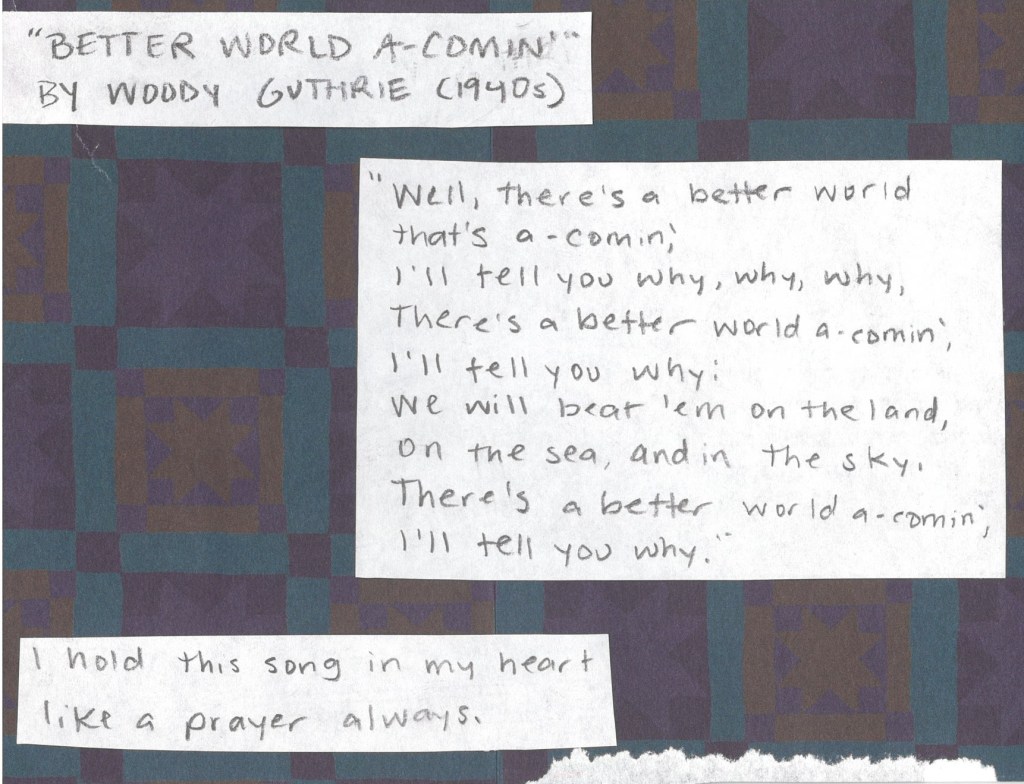
    Better World A-Comin' by Woody Guthrie from the 1940s
“Well, there’s a better world that’s a-comin’,
I’ll tell you why, why, why,
There’s a better world that’s a-comin’
I’ll tell you why:
We will beat ‘em on the land, on the sea and in the sky,
there’s a better world that’s a-comin’, 
I’ll tell you why.”
I hold this song in my heart like a prayer all the time.
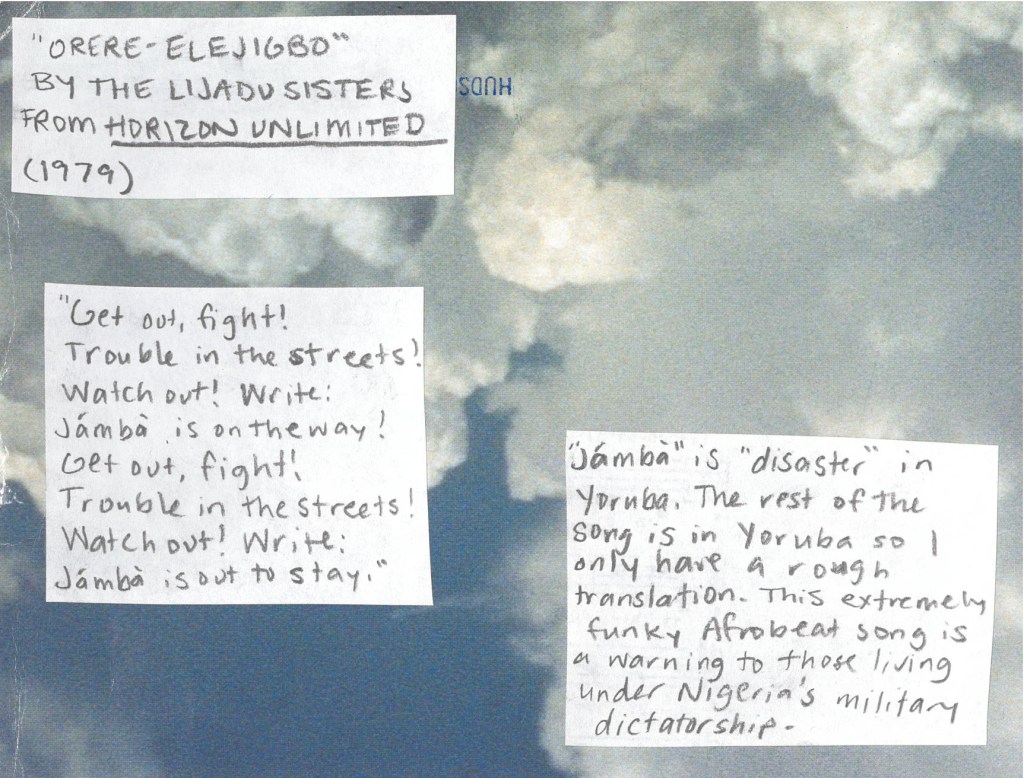
    Orere Elejibgo by The Lijadu Sisters from 1979
“Get out, fight! 
Trouble in the streets! 
Watch out! Write, ‘Jamba is on the way!’
Get out, fight! 
Trouble in the streets!
Watch out! Write, ‘Jamba is out to stay!’”
“Jamba” is “disaster” in Yoruba. The rest of the song is in Yoruba, so I only have a rough translation, but this extremely funky Afrobeat song is a warning to those living under Nigeria’s military dictatorship.
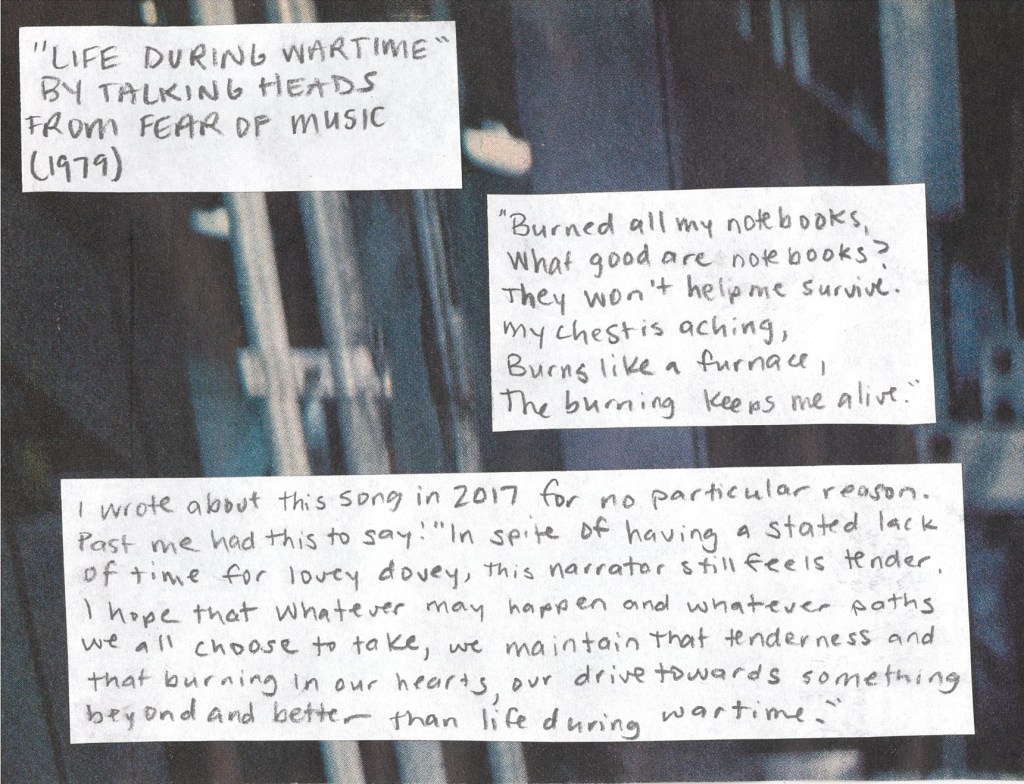
    Life During Wartime by Talking Heads from 1979
“Burned all my notebooks. 
What good are notebooks?
They won’t help me survive.
My chest is aching, 
Burns like a furnace,
The burning keeps me alive.”
I wrote about this song back in 2017 for no particular reason. Past me had this to say:
“In spite of having a stated lack of time for lovey dovey, this narrator still feels tender. I hope that whatever may happen and whatever paths we all choose to take, we maintain that tenderness and that burning in our hearts, our drive towards something beyond and better than life during wartime.”
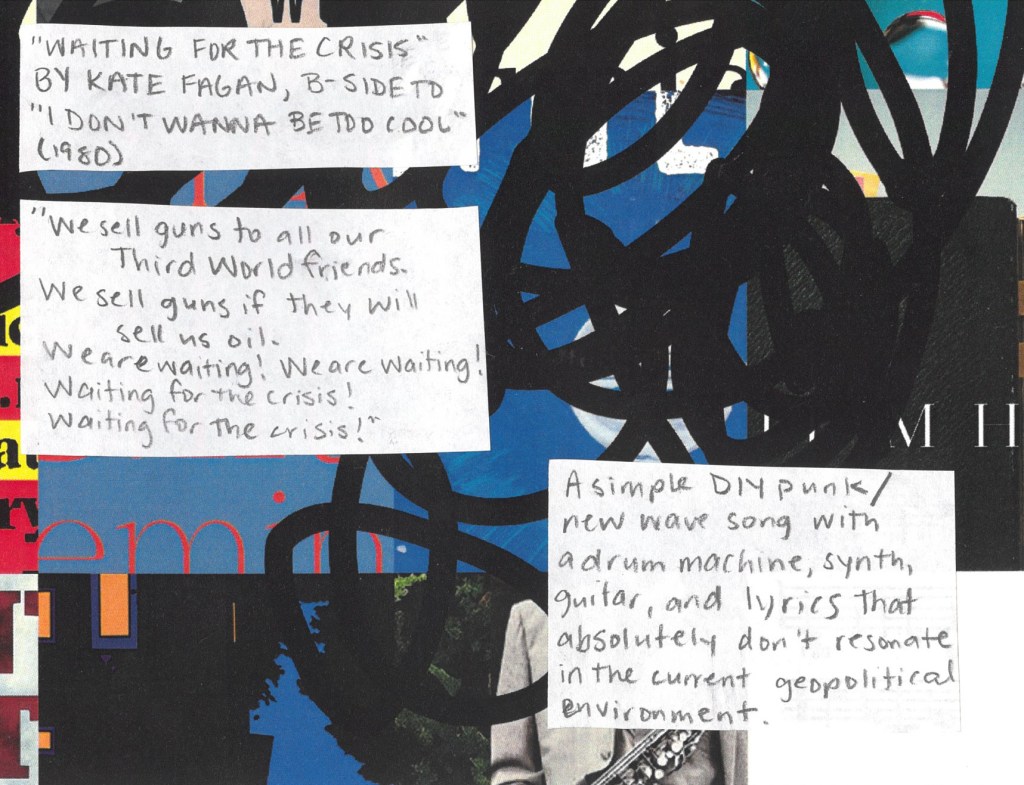
    Waiting for the Crisis by Kate Fagan from 1980
“We sell guns to all our Third World friends.
We sell guns if they will sell us oil.
We are waiting! We are waiting!
Waiting for the crisis! Waiting for the crisis!”
A simple DIY punk/new wave song with a drum machine, guitar, and lyrics that absolutely don’t still resonate in the current geopolitical environment.
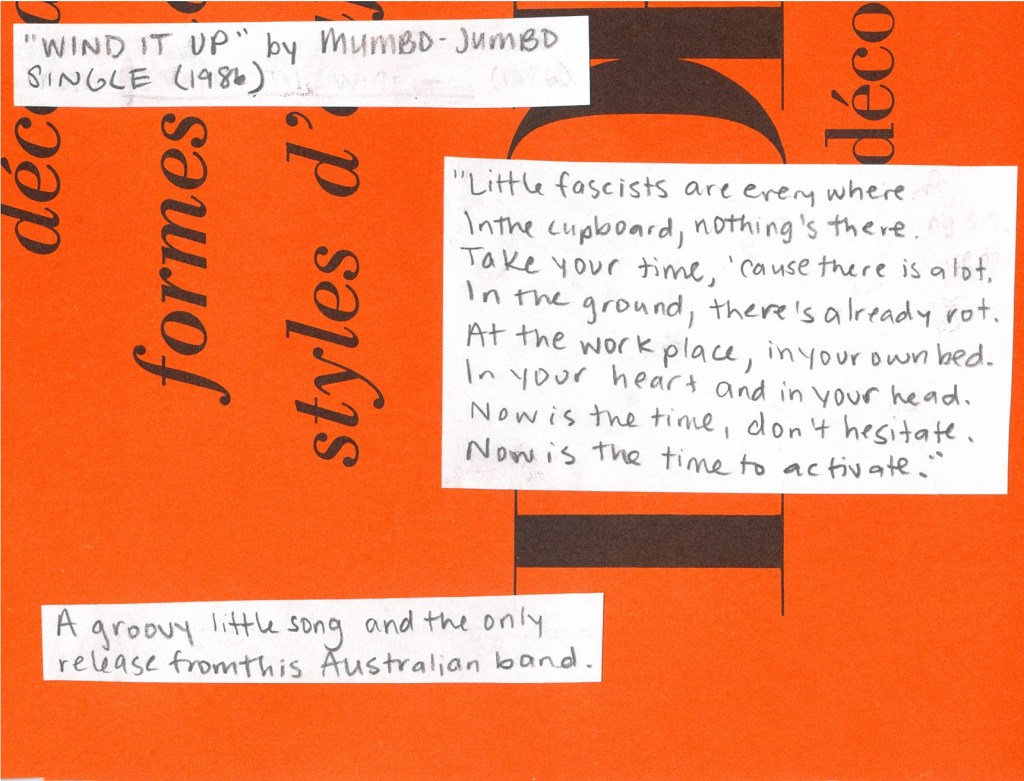
    Wind It Up by Mumbo Jumbo from 1986
“Little fascists are everywhere.
In the cupboard, nothing’s there.
Take your time ‘cause there is a lot. 
In the ground, there’s already rot.
In the workplace, in your own bed,
In your heart and in your head.
Now is the time, don’t hesitate.
Now is the time to activate.”
A groovy little song and the only release from this Australian band.
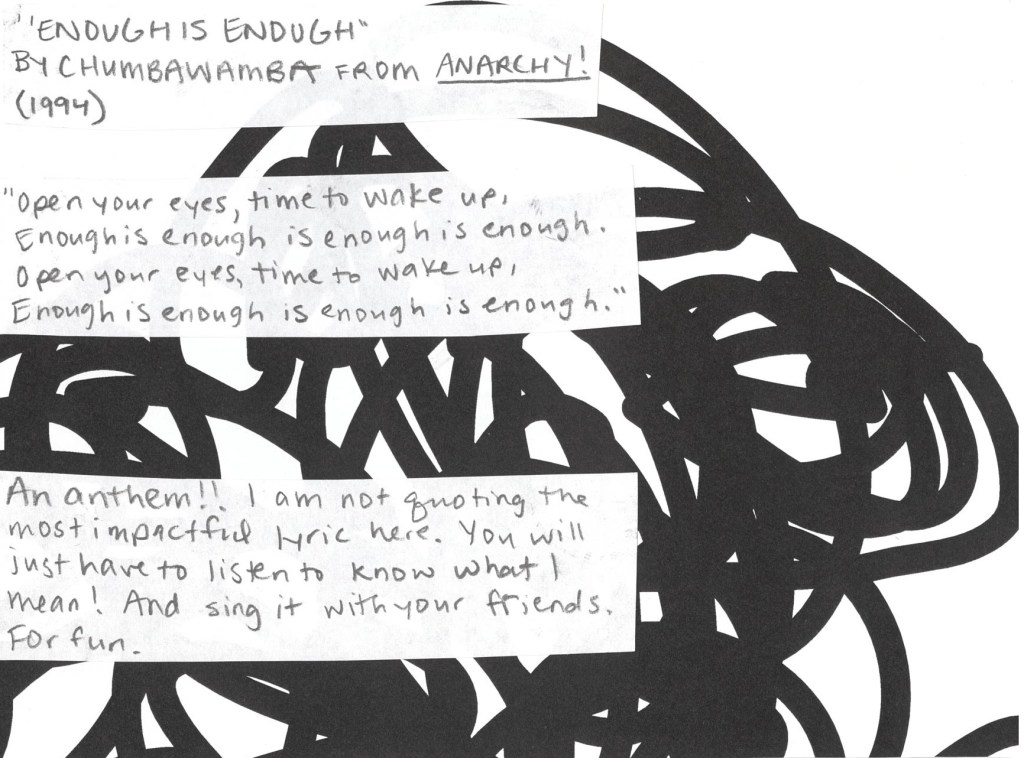
    Enough is Enough by Chumbawamba from 1994
“Enough is Enough” by Chumbawamba from Anarchy! (1994)
“Open your eyes, time to wake up,
Enough is enough is enough is enough.
Open your eyes, time to wake up,
Enough is enough is enough is enough.”
This song is an anthem!! I am not quoting the most impactful lyric here. You will just have to listen to know what I mean! And then sing it with your friends. For fun.
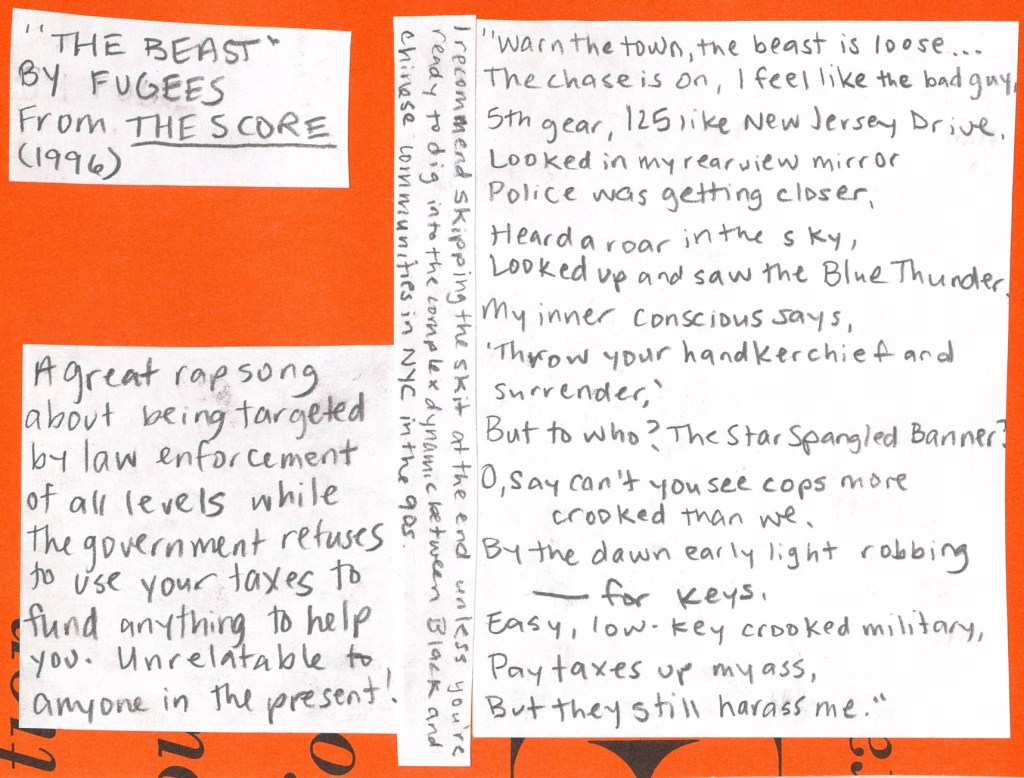
    The Beast by The Fugees from 1996
“Warn the town, the beast is loose…
The chase is on, I feel like the bad guy,
Fifth gear, 125 like New Jersey Drive.
Looked in my rear view mirror
Police was getting closer.
Heard a roar in the sky, looked up and saw the Blue Thunder.
My inner conscious says, ‘Throw your handkerchief and surrender.’
But to who? The star spangled banner?
Oh, say can't you see cops more crooked than we
By the dawn early night, robbin' n—-- for keys
Easy, low-key crooked military
Pay taxes up my ass, but they still harass me.”
A great rap song about being targeted by law enforcement of all levels while the government refuses to fund anything that would actually help you. Unrelatable to anyone in the present! 
I recommend skipping the skit at the end unless you're ready to dig into the complex dynamic between Black and Chinese communities in NYC i the 90s.
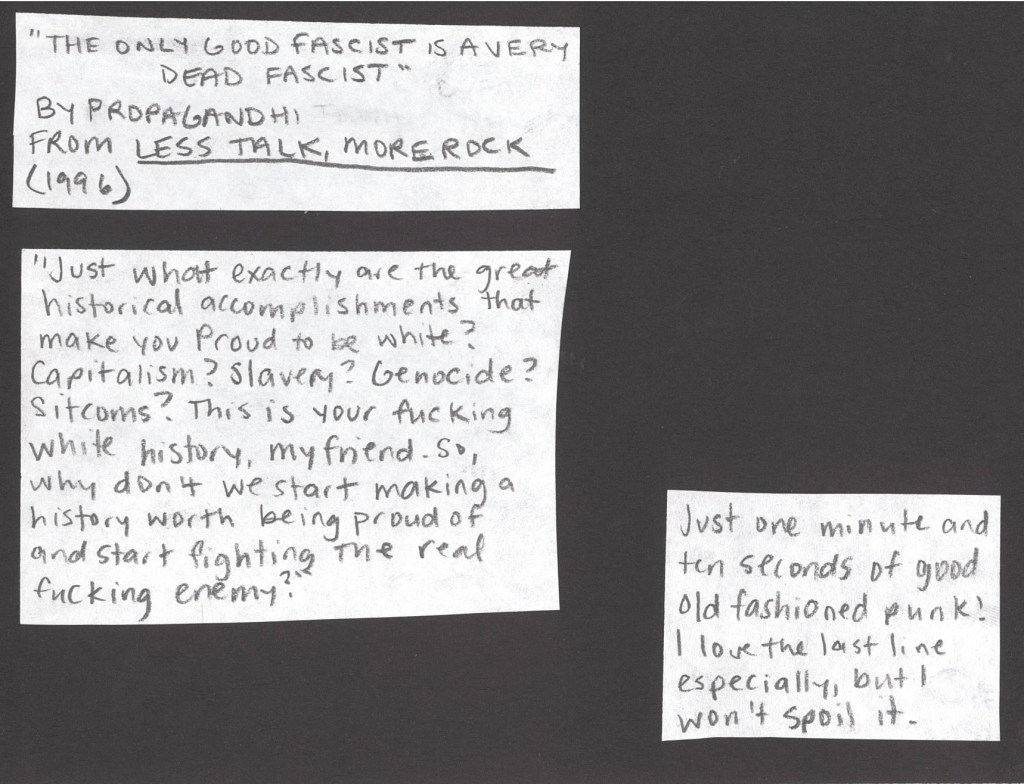
    The Only Good Fascist is a Very Dead Fascist by Propaganhi from 1996
“Just what exactly are the great historical accomplishments of your race that make you proud to be white? Capitalism? Slavery? Genocide? Sitcoms? This is your fucking white history, my friend. So why don't we start making a history worth being proud of and start fighting the real fucking enemy?”
Just one minute and ten seconds of good old fashioned punk! The last line of this song is my favorite, but I don’t want to spoil it.
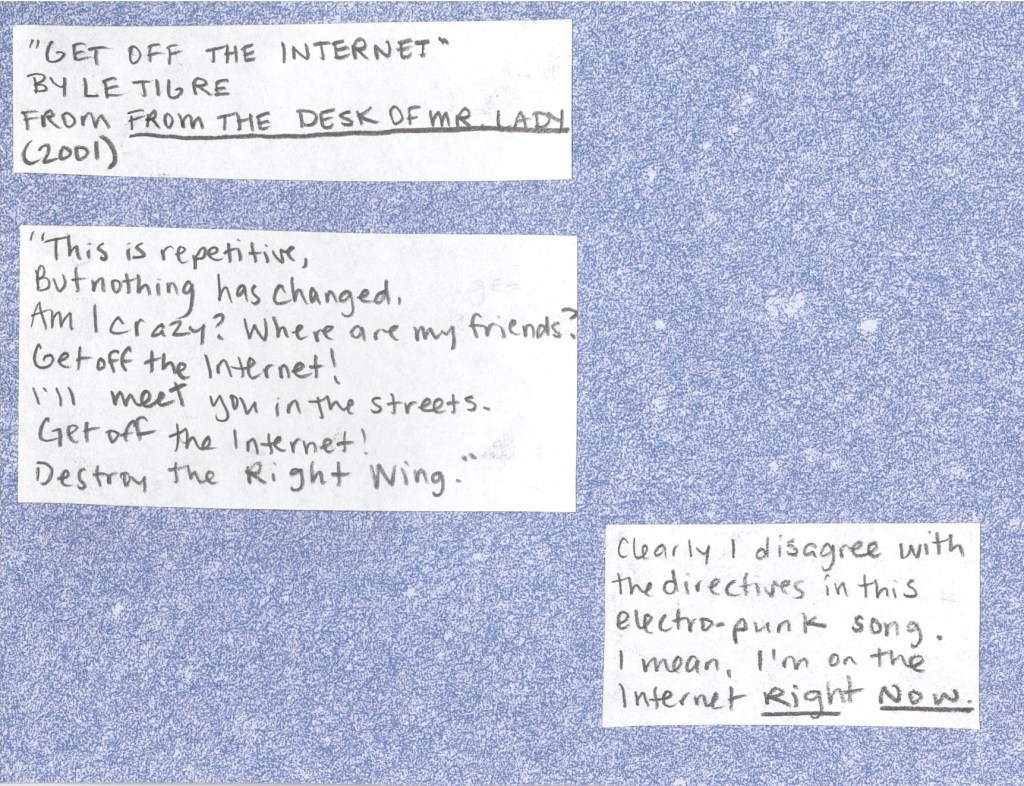
    Get off the Internet by Le Tigre from 2001
“This is repetitive, 
But nothing has changed.
Am I crazy? Where are my friends?
Get off the Internet! 
I’ll meet you in the streets. 
Get off the Internet! 
Destroy the Right Wing.”
Obviously I disagree with the directives in this electro-punk song. I mean, I’m on the Internet right now.
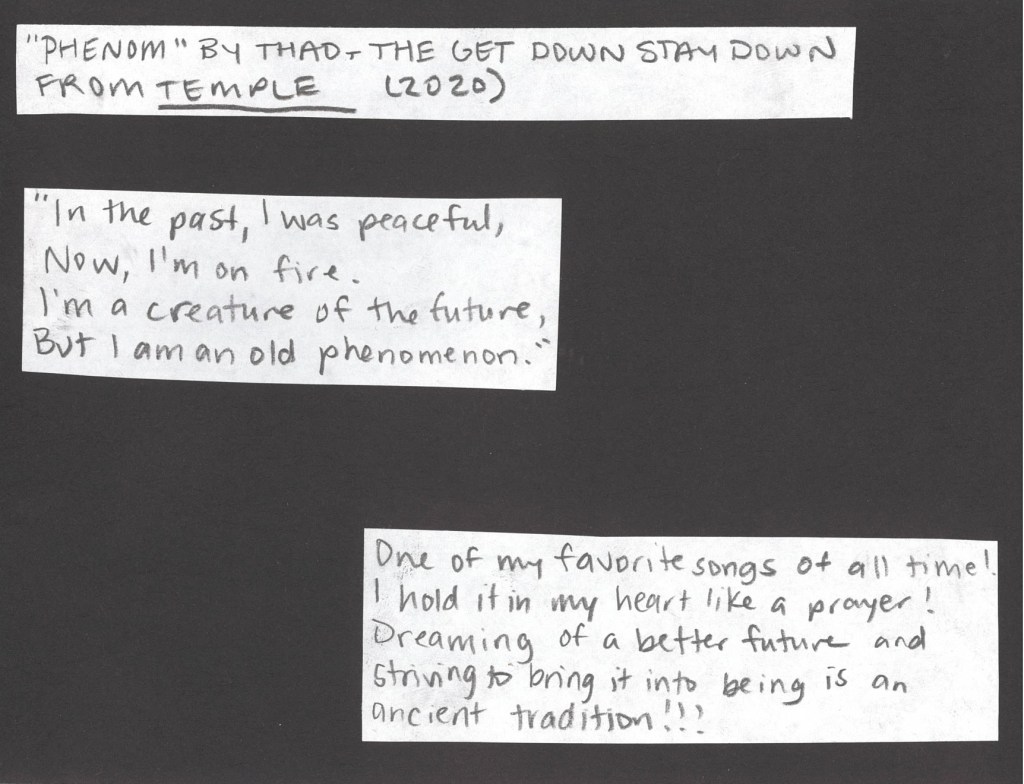
    Phenom by Thao and the Get Down Stay Down from 2020
“In the past I was peaceful,
Now I’m on fire.
I’m a creature of the future,
But I am an old phenomenon.”
This is one of my favorite songs of all time!!! I hold it in my heart like a prayer! Dreaming of a better future and striving to bring it into being is an ancient tradition!!

  • NoodiMag Volume 4

    Welcome to NoodiMag, the container for all my noodling on noodles, pastas, and all related topics.

    Pasta Shapes Consumed: Pierogy; Gemelli; Lasagne (no ruffled edges); Miniature Shells; Round Ravioli; Fettucine 

    Total Pasta Shapes To Date: 14

    The Appetizer:

    I feel as though I am stagnating in the quest to have as many pastas and noodles as possible. My most loyal readers will notice a lot of repetition, and only a few new shapes each fortnight. I can’t quite tell if 14 varieties in six weeks is a lot. It’s probably more than average. Is it a sustainable rate if I’m to keep this up all year? Also hard to tell. In the most romantic part of my heart, I want each pasta dish I eat to be a new type, but this is not the reality of groceries and cooking in the world as it is. In the most neurotic part of my heart I want to get through every type by the end of the year, but there are hundreds upon hundreds, and I do actually like to eat other foods. As mentioned in Volume 2, I have to remind myself that this is not a goal of rigidity and endurance, but of pleasure and experience.
    The real goal, I think, is a deeper appreciation for the craft and for the subtle changes that make a big difference. For instance, this week I’ve eaten both pierogy and ravioli. You could argue that these are more or less the same thing with different fillings, and you would be wrong. In comparing these two dishes, I can appreciate just how much the method of sealing the dumpling alters the experience. I also have been reading about how much the type and quality of wheat used can alter the texture, and I’m fairly certain these two products use different wheats, despite both simply listing “wheat flour” as an ingredient. These are things I’ll be looking out for as I continue this journey.
    I’m starting to get caught up in the intellectual side of things. Maybe it’s all the Aquarian energy lately. I’ve learned just enough in my research that it’s all very exciting, and a little overwhelming, and it’s hard to stay focused. There’s so many ideas and connections and inspirations, it’s difficult not to just end up hollering incoherently about it until I wear myself out. Just as with the embodied side, this is an exercise in pacing myself. Welcome to my attempt to shift my hyperfixation process. Here’s a taste of what I’ve been learning…

    The Entree:

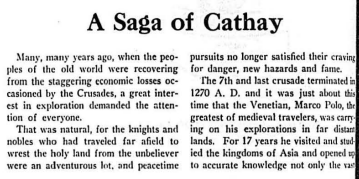
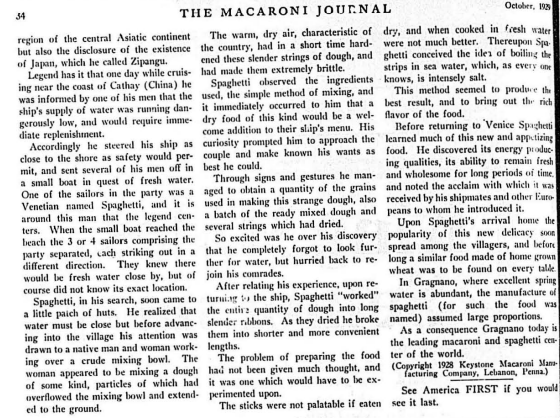
    After last issue’s ponderings on pad Thai noodles, known in Thai as Kuai tiao (ก๋วยเตี๋ยว) and based on a noodle of Chinese origin transliterated as guotiao and also called shahe fen (“fen” being the Mandarin for noodles made of starches besides wheat), I began to really wonder in earnest about our terminology, its etymologies, what is being communicated by using one term over another, whether we could be using the Italian term “pasta” and the Mandarin term “mian” interchangeably, as they both mean “noodles made with wheat.” At the start of these particular ponderings, I was operating under the impression that all preparations of ground wheat, water, salt, and maybe egg formed into various shapes originated in China and were brought to Europe by Marco Polo in 1295. I found, though, that this is a myth created by advertisers in 1929 and resented by Italians. The story was first published in Macaroni Journal, the trade magazine of the National Pasta Association (formerly the National Macaroni Manufacturer’s Association), which went out of print in 1984 and the haphazard archival scans of which I have been reading and immensely enjoying. (Expect more on this window into a niche community at a later date.)

    Instead, the true origins of pasta, mian, and other similar foods are murky, ancient, and completely independent of one another. It appears that wherever wheat is grown, humans have ground its fruit, combined it with water, and shaped it into something delightful. The oldest known archaeological evidence of noodles was found in a 4,000 year old ceramic bowl excavated in Qinhai, China. References to pastas and noodles are found in surviving texts from Ancient Rome and Greece, including a Greek myth wherein the muse Thalia inspires Macareo to build an extruder and make pasta for poets. In the 9th Century AD, Arab-Spanish entertainers sang songs extolling the virtues and elegance of noodles. There are many more examples. I could very easily get lost in the sauce, so to speak, on the ancient tradition of loving pasta and noodles, and I will over time. The point I mean to make here today is that the communities around the Mediterranean Basin already had many, many variations on what we now call pasta by the time Marco Polo made his expeditions to China.
    What actually happened when Marco Polo ventured to China is this: he saw their noodles and he wrote in his travel log whatever the Medieval Italian equivalent is of, “Holy shit, they have lagane here, too!!!” At the time, “lagane” was a common term in Europe for everything that we might call pasta or noodles today. This comes from the Greek “laganon,” referring to strips of dough made of flour and water, and would become “lasagne.” “Macaroni” was also in use around this time, as well as a number of other terms in local languages and dialects.
    Later, in the Renaissance period, when it became more common to purchase dried pasta in the market than make it at home, it was all called “vermicelli.” In the 18th and 19th Centuries, which saw the unification of Italy, mass migration from Italy to the United States, and the dawn of mass manufacturing as never seen before, it all came to be known as “macaroni.” It is only very recently– as in only since the mid-20th Century– that “pasta” has become the common term for all of these culinary preparations. In Italy, the legal term is “paste alimentari,” while in the United States, our regulations around these products are largely from the early 20th Century, and so still refer to “macaroni products.” I’m still learning how and why all these language shifts happened, but the growing uniformity across some geography and not others has much to do with imperialism, nationalism, and globalization, and we will continue to dig into all of that. 

    The Dessert:

    I’ll leave you with memes today…

    Thanks for reading! Maybe next time will be better. 
    Works Cited:

    Montanari, M. (2021).  A Short History of Spaghetti with Tomato Sauce: The Unbelievable True Story of the World’s Most Beloved Dish. (G. Conti, Trans.) Europa Editions. 

    Shelke, K. (2016).  Pasta and Noodles: A Global History. Reaktion Books Ltd.

  • NoodiMag Volume 3

    Welcome to NoodiMag, the container for all my noodling on noodles, pastas, and all related topics.

    Pasta Shapes Consumed: Casarecce; Miniature Shells; (Elbow Macaroni); Rice Elbow Macaroni; Mezzanini Rigati; Gemelli; Rotini; (Pad Thai Rice Noodles)

    Total Pasta Shapes To Date: 8 (10)

    The Appetizer:

    The schema for what we mean by “eat as many pastas as I can” continues to be built as we go. I have had a few discussions now with my companion in this goal about what can count towards our final numbers. Did we mean shapes? Did we mean types? Did we mean strictly unleavened dough made of wheat flour mixed with water or eggs? Or do we mean the more expansive definition that includes gluten-free options made of rice and legumes? Do we mean Italian noodles or do all the noodles of the world count? Do zoodles count at all? Where does gnocchi fit? Much to consider! As someone with a degree in Classification and Categories, I am absolutely considering it daily. 

    At issue in this issue is whether the rice noodles in my pad Thai count towards the goal, and if so, how. Do they count for the linguine shape? Or does the fact of their holding sauce differently and having a different texture and a different origin make them a separate entry from the true linguine I will undoubtedly have later in the year? 

    Across the last issue and this one, I count three different macaronis: one made with rice, two made with wheat, all distinct sizes and shapes. This is another issue, because there are many noodle shapes we might call “elbow macaroni,” and technically many things legally fall under the category “macaroni product.” It’s all very fuzzy, as all categories are, which is lucky for me and my secondary goal of writing about pastas and noodles with regularity. We will not be getting to the bottom of this! And that’s part of the fun.

    The Entree:

    I already have to admit that I have led my beautiful readers astray. In the last issue, I referred to Barilla as “a pasta brand that we do not fuck with.” I said that I may explain the reasons in a future issue, and as I began to search for sources for those reasons, I realized that I perhaps overstated how much we do not fuck with Barilla.

    For several years now, I have refused to purchase Barilla products, even though they are often the least expensive option and offer the widest variety of shapes, because in 2013 chairman and member of the Barilla family, Guido Barilla, made some comments about what family should look like that involved homophobia and some very traditionalist ideas about women’s roles. He said that if we were offended, we could simply eat another pasta. The other major pasta brands, of course, jumped on this and posted on social media about how much they like it when the gays purchase their enriched macaroni products. Way back in 2013, we were a valuable market!

    I am on record on this very blog as saying, “I love a boycott and will hold a grudge against a corporation for the rest of my life,” so I did not bother to keep up with this issue and learn that Guido very quickly apologized and promised to meet with “representatives of the groups that best represent the evolution of the family, including those who have been offended by my words.”

    In 2018, Barilla sponsored the launch of Openly, a global digital news platform operated by the Reuters Foundation focused on LGBT+ issues. They announced this sponsorship in the same press release where they announced they would employ and train refugees at their plants throughout Europe, with the goal of employing upwards of 75 refugees over five years. Their Chief Diversity Officer had some really nice things to say in the release.

    I also read their 2022 and 2024 Sustainability Reports. They met their goals for employing and training refugees early, and so they launched a new mentorship program specifically for refugee women. They also were ranked one of the best places to work for LGBTQ+ people in 2022. They say they do their best to source cane sugar, cocoa, and materials for technology in ethical ways. They have Animal Welfare Guidelines. They’ve got Climate Risk Assessments and related goals. They have a Disability Inclusion Roadmap and they’re getting into Design for All. They claim to work well with trade unions, to support the farming communities located close to their plants, to have some level of transparency about accidents in their workplaces, and more. 

    I don’t know, man! They’re saying all the right things now! It’s all in corporate buzzwords, but I am finding it hard to be a total and complete hater at this point. 

    I will still maintain my grudge, though. They are, after all, still a multinational corporation owned by an even larger corporation owned by an even larger multinational conglomerate. It does appear, though, that… they may be moderately less evil than others among their ilk. 

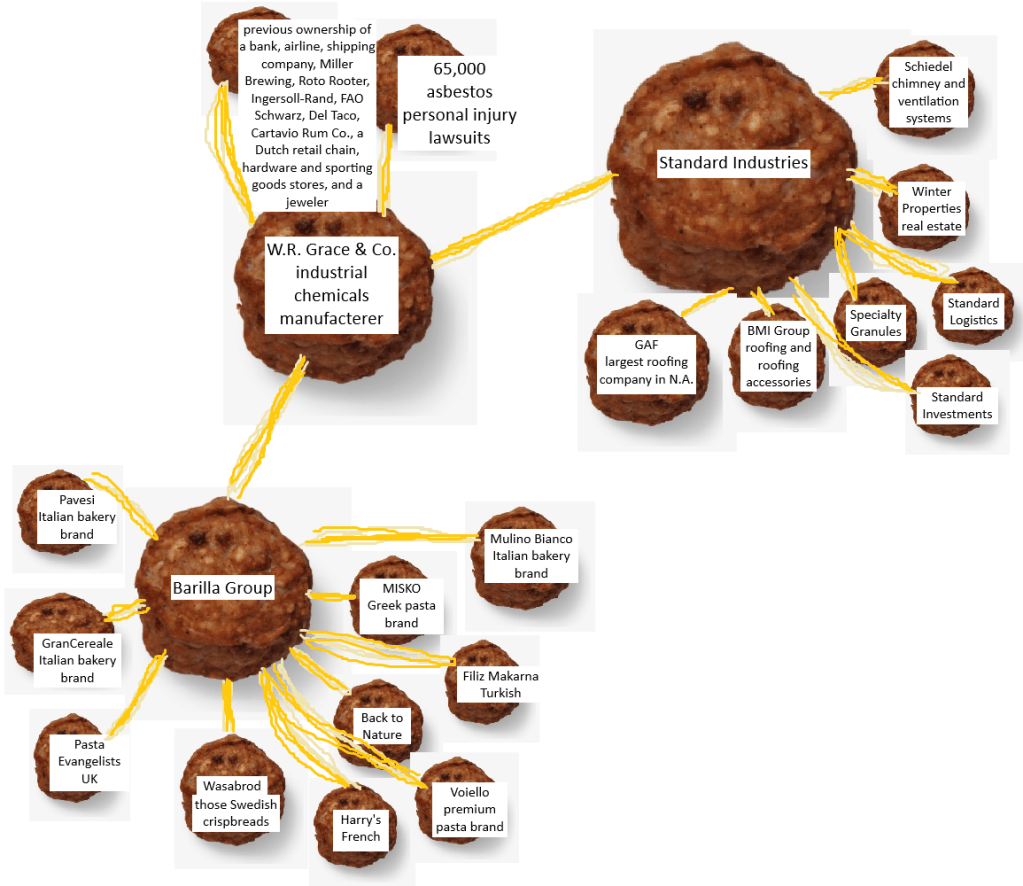
    Below you can see their corporate ownership through a diagram inspired by a plate of spaghetti and meatballs. It’s not great! There’s a lot of construction and chemical manufacturing going on! But at least I didn’t find any defense contractors?? 

    (Small correction: Pan di Stelle is also a Barilla Group brand that used to be under Mulino Bianco, but became its own brand in 2007. The diagram does not reflect this. Or the continued existence of Catelli, a Canadian pasta brand owned by Barilla Group.)

    So, last time I was at the grocery store, I gave Barilla $2.00 for their limited edition snowflake-shaped pasta. I still had four pounds of pasta from Costco in the pantry, but it’s limited edition. They have a heart-shaped limited edition pasta as well, which I may get next time. I have not tried the snowflakes yet, but they will be covered in a future issue, along with the ethics of the other major pasta brands.

    The Dessert:

    This issue’s dessert is actually about a dessert.

    I’m thinking about spaghettieis. Spaghettieis is a dessert invented by second-generation Italian-German, Dario Fontanella, in Baden-Wuerttenberg, Germany in 1969. It’s ice cream that looks like spaghetti! It’s inspired by Mont Blanc, a French dessert where a chestnut puree is put through a Spaetzle press and topped with whipped cream, so it looks like if spaghetti was a mountain, namely Mont Blanc. (Spaetzle is a pasta specific to Central Europe. We’ll talk more about it another time.) Dario decided to make something that sounded good, so he put vanilla gelato through a Spaetzle press and then put strawberry sauce and shaved white chocolate on top. It looks like spaghetti!!

    Many, many years ago, before Guido even put his foot in his mouth, I had the chance to eat spaghettieis in its place of origin. Instead, I just got a classic chocolate cone. Don’t get me wrong, that was still one of the best ice cream cones I’ve ever had, but I now understand 17 year old me was making bad choices in ways I couldn’t have fathomed at the time. It doesn’t appear that any ice cream or gelato shops near me offer this treat. How long do I fixate on it before I have to get a Spaetzle press and make it myself?

    Thanks for reading! Maybe next time will be better.
    Works Cited:

    Barilla. (2018, September 27). Barilla commits to refugee training and sponsors new LGBT+ news platform as part of ongoing diversity and inclusion journey.

    Barilla. (2022). The Joy of Food for a Better Life: Sustainability Report 2022.

    Barilla. (2024). The Joy of Food for a Better Life: Sustainability Report 2024.

    Edelbaum, S. (2023, August 12). Spaghettieis: a trick ice cream sundae. BBC.

    McCoy, K. (2013, September 30). Barilla exec apologizes for remarks on gays. USA Today. 

  • NoodiMag Volume 2

    Welcome to NoodiMag, the container for all my noodling on noodles, pastas, and all related topics. This is volume 2 because, way back in November 2022, I wrote one singular joke version of this idea, sent only to my wife. I’ve been talking about doing this niche newsletter, and actually sending it outside my household, and calling it NoodiMag for over a year now, and I finally have the motivation to really do it, because for 2026 a friend and I have set a mutual goal of eating as many different pastas as we can, inspired by this video. I’m excited for what this particular part of the future holds. If the First Summer of Soft Serve taught me anything, there are good things coming. So, here we go…

    Pasta Shapes Consumed: Gemelli; Miniature Shells; Tortellini; Macaroni; Casarecce; Rice Elbow Macaroni; Rotini

    The Appetizer:

    Am I really eating every pasta I can? If you ask the most literal part of my brain, the answer is no. I was at a diner one night, and I noticed that they had Fried Ravioli on the menu. I thought to myself, “I like Fried Ravioli, and that’s a pasta. I should get that. For the goal.” Did I get it? No! I got a sandwich. It was a really good sandwich, except it cut up my mouth. (Why have we all accepted having our mouths cut up on an overstuffed sandwich on toasted bread? My next stupid campaign will be to put an end to this.) And at the grocery a few days later, I walked right by the pasta aisle. Then I started to turn back. For to get another pasta shape. But then I thought to myself, “I have six pounds of pasta from Costco at home. I can wait to get another pasta.” Another night I was having lemon drop martinis with a friend at a restaurant with lots of pasta on the menu. I could’ve gotten some of them without even leaving off key ingredients to make it vegetarian. But I ate a salad and fancy cheese instead and they were really delicious. So, that’s three times I passed up pasta that I could have had. Except that I didn’t want to, so could I really have? I suppose these moments helped to define the goal. This is about exploration and enjoyment. This is not about rigidity or purity. Though, over a week later, I am still thinking about the Fried Ravioli That Wasn’t. I’ve learned my lesson there.

    The Entree:

    I am convinced that eating a slightly-too-large bowl of pasta, watching an episode of TV, and then having a big, huge nap is an effective home remedy for chronic pain, chronic fatigue, and, possibly, whatever else might ail you. At least whatever else might ail me.

    Frequently, when I am having a flare of my chronic illness, I will put this to the test. I will make just a little too much of the Basic Pasta Meal: whatever pasta shape I grab first out of the pantry, vegetarian ground “be’f”, marinara sauce from a jar, and mozzarella and/or parmesan cheese. Sometimes I put red pepper flakes in it, or extra garlic, or fresh tomatoes if I have them. Probably we all have had some version of this in heavy rotation for our entire lives. It wasn’t vegetarian when I was a kid, and it didn’t include the cheese, or any of the extras, but it’s always been the same basic concept. It’s a classic for a reason.

    I eat it until I’m just a little too full. I watch an episode of a hour-long network TV drama, and then I go to sleep. I always wake up feeling so much better.

    This is what I did on the first day of Greg’s New Year. I was hit with a wave of exhaustion and pain in the early evening. I thought maybe I was sick. I didn’t even stay up that late or consume any substances for New Year’s Eve! My wife made me Basic Pasta Meal. I dozed on the couch to one and half episodes of Gilmore Girls. Then, I went to bed very early. In the morning, I felt totally fine. I mean, as fine as you can be while having a chronic illness flare.

    As it turns out, They, the Scientists, are finally starting to research this. Or consider researching it.

    In May of 2025, a group of scientists published a study protocol in Trials, a leading journal that publishes designs for randomized controlled trials in health, with the goal of improving trial design. The hypothesis of this would-be study is that carbohydrate intake shortly before sleeping may improve sleep by increasing the availability of tryptophan, which is crucial to serotonin production, which in turn modulates the sleep-wake cycle. It appears so far that this study has not actually happened yet. And it also appears that this study protocol and potential actual study is/will be funded by Barilla, a pasta brand that we do not fuck with, for reasons I may explain another time (Lotti et al, 2025). Now, they say that the funding source won’t affect the results, but they always say that and… I’m skeptical. Barilla’s got a concerted interest in combating “carbophobia” as they call it. I do believe this to be a noble cause, though, and so we have a case of strange bedfellows.

    Research also shows that carbohydrate consumption is essential to restoring muscle glycogen, the fuel source for our muscles during exercise. During physical activity, muscle glycogen is broken down and oxidized into the molecules needed for muscle contraction. Our glycogen stores need to be replenished in order to perform physical activity again (Murray & Rosenbloom, 2018). I’m not an athlete, but sometimes my body feels like I ran a marathon after doing a normal day.

    Is this scientific backing for my pasta-based home remedy? Perhaps. It is most certainly your invitation to join me in this experiment. Give this protocol a try the next time you feel like shit, and let me know how it goes.

    The Dessert:

    This is the meme a coworker caught me looking at instead of working:

    She asked, “That sketti??”

    Pretty apropos. when the coworker thinks ur working but really you’re looking at memes of spaghetti

    Thanks for reading! Maybe next time will be better.
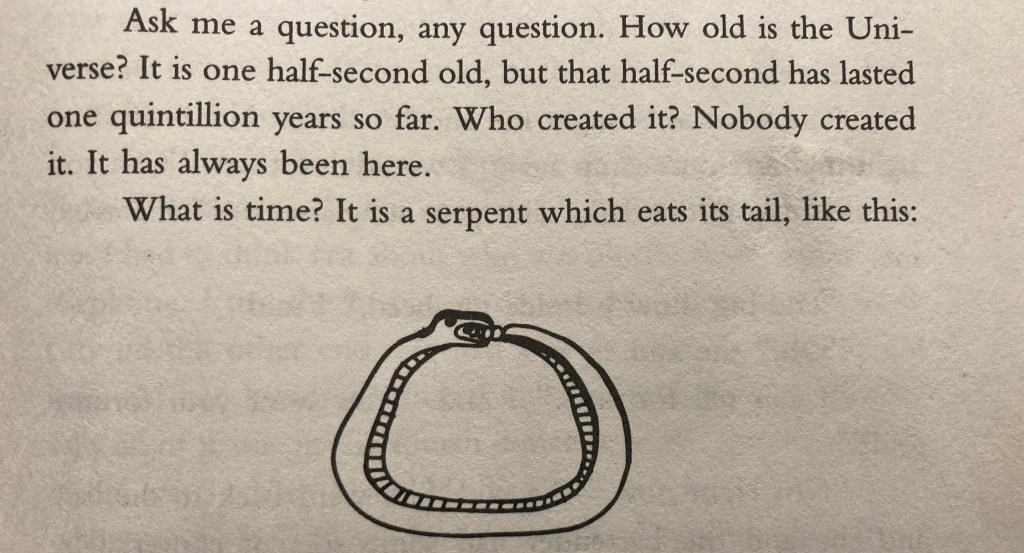
  • Kurt Vonnegut’s ouroboros in Breakfast of Champions

    I chanted Torah for the first time yesterday. This is a big deal in and of itself! I’m finally, at 31 years old, a bat mitzvah. Or a b’nai mitzvah? The gender part isn’t that important here; the point is that I’ve gotten to do the thing that, to some, makes me officially an accountable person in my Jewish community. Someone who is responsible for their own actions, who should be held to account for their mistakes. 

    Obviously I’ve been striving towards accountability (with varying degrees of success) for many years. And obviously my peers who are whole adults that don’t know how to read the Torah are also responsible for themselves. But, having gone through the process of learning to read and chant the Torah, I can appreciate this as a rite of passage that proves you are ready to carry your own self through the world. 

    Here is the most sacred object in our tradition. Here is one of the most sacred tasks. Here is the difficult work of parsing out multiple layers of ancient symbols, two thirds of which disappear when you look at the actual scroll, replaced with embellishments that make familiar letters turn unfamiliar again. In turning the symbols into sounds, one joins a millennia old oral tradition that started in the din of marketplaces, blending the divine and the mundane. And you’ve studied it a bunch, and you’ve practiced it until you can say it almost completely from memory, and now you have to do it in front of a bunch of people, so there’s the interpersonal aspect, and the performance anxiety aspect, and the self-confidence aspect, along with all that ancient, traditional, spiritual stuff. 

    Personally, I love the Torah. Not her content necessarily, but all that she represents. When I hold her I feel like I’m holding a precious baby who is also an ancient ancestor. That’s kind of what’s happening, is it not? Even to many secular Jews, the Torah represents the unbroken passage of Jewish knowledge from generation to generation, the connection to the ancestors and their wisdom, something holy even in the absence of belief in g-d. The arguing about her, the critiquing and criticizing her is a holy act. Not being so sure that this text is the best one for the World’s Oldest Book Club is its own kind of reverence. It is no small thing to learn her ways. 

    So, yesterday was Simchat Torah. This is the day that, three weeks into the new year, we complete our Torah reading cycle and begin it anew. We unroll the Torah, completely if you can, in the most stressful group project ever. We’ve got this sacred and fragile object. We’ve got a bunch of people, including myself, who suddenly forget left from right and how to follow directions. But once you get her unrolled as far as you can, you can see the whole story, or most of it, laid out before you at once. There are places where the text becomes a concrete poem, markers for significant moments in the journey. And because the Torah cycle is linked to the Hebrew calendar, these can become markers of significant moments of our lives.
    We read the very last verses of Devarim, or Deuteronomy, where Moses dies and it is proclaimed that there will never be another prophet as great as him, and we immediately launch into Bereshit, or Genesis, where Creation begins again with the separation of light and dark, day and night. We are always in a state of becoming. Endings and new beginnings do not unfold all at once. And endings and new beginnings are one in the same. 

    So, I got to chant these last verses of Devarim and these first verses of Bereshit. This alone is an extra cool piece of Torah to have for your first aliyah*! And I’m here to tell you the extra layers of why it was significant for me. 

    Three years ago on Simchat Torah, I was still in the process of converting. To be clear, I believe I have always been Jewish, but that, for reasons I still don’t quite understand, g-d felt the need to make me learn and then unlearn Protestant prudishness and a self-destructive work ethic. This is a story for another time. For our story today, it’s important to know that three years ago I was yearning to hold that Torah but couldn’t!! I was so envious of the people holding her and dancing with her!

    Some time in the following spring, I finally, technically, completed all the steps of conversion. Every part of it was not quite right, though. I say “some time” because I don’t actually remember what day it happened. I wanted to pick some special or memorable date for my beit din** and mikveh*** and welcoming to the community, but that didn’t pan out. 

    In my beit din, when three rabbis from the local community asked me about my journey to Judaism and what kind of Jew I wanted to be, they asked me what issues I have with Judaism. I gave my practiced, carefully worded answer about Zionism. I was still afraid that if I was too honest about Palestine, they would deny me, but I also had to be honest that my biggest struggle was that every mainstream Jewish institution is ardently Zionist, unwaveringly supportive of a violent ethnostate and occupation, even when they’re allegedly progressive.

    I could cope with the fact that fundamentalists would never think I count. I could even cope with the queerphobia and the patriarchal practices that permeate a lot of Jewish spaces, though maybe I shouldn’t. But I couldn’t quite cope with tacit, seemingly unquestionable support for slow, deliberate ethnic cleansing, so, I had to say so, even though it made me nervous.

    They didn’t deny me, in this instance, and I had my mikvah. The cantor**** I’d been meeting with told me to take my time, and so I did. What he actually meant, it turns out, was, “Hurry up, we have other places to be.” 

    And so this pivotal moment in my spiritual life was rushed, and clouded over by Zionism, as so much of Jewish life is.  

    I thought I would get to appear before the congregation at our synagogue, maybe give a speech, maybe explain the name I’d carefully chosen for myself, definitely receive a blessing, and be witnessed in this confirmation of what I had known about myself for many years. 

    There was no appearance before the congregation. There was no witnessing beyond one Shehechiyanu***** from my beit din rabbis and the pride of my soon-to-be wife and a few friends I told about it.

    When the cycle of the year rolled back around to fall, Simchat Torah came again. 

    I was getting married in a week. You’re supposed to receive a blessing on the Shabbos before your wedding. None of our clergy had offered this to us, despite being the ones who would be officiating our wedding. I asked that afternoon, “Could we please squeeze this in? It’s important to us.” 

    This was the first time either of us appeared before the members of our synagogue we’d been attending for years. The first time many of them knew we existed. We received our blessing, we helped unroll the Torah, we heard the ending and beginning chanted. We went outside to celebrate. 

    This time, I was so excited. I was going to hold the Torah and I was going to dance with her!! The moment came. Someone handed her off to me. I started to dance. I was so happy!! And then, a clergy member came up to me in a panic and took her from me. The celebration continued. Others held her and danced wildly with her. And so this pivotal moment in my spiritual life was cut short. I was left confused and hurt. It seemed they did not trust me with her. 
    This was the last time we ever set foot in that synagogue, ever celebrated with those people.

    That day was October 7, 2023, in the Gregorian calendar. I found out the next day that something was happening in Palestine. 

    Yesterday was the Hebrew calendar’s anniversary of that day. 

    Yesterday was also the Gregorian calendar’s anniversary of the day I got married to my wonderful wife. 

    In our wedding ceremony, we did what any responsible Jews would do: we radically changed traditional wedding rituals to reflect our non-hierarchical, non-patriarchal, queer diasporist values. 

    To give my favorite example, we replaced the breaking of the glass with the breaking of pinecones and acorns and buckeyes. Breaking the glass traditionally holds sorrow at the destruction of the First and Second Temples. We’re supposed to grieve this every chance we get and yearn for the Temple to be rebuilt, but my wife and I don’t. The destruction of the Temple, the end of a place-based Judaism, is the creation of Rabbinic Judaism, the beginning of the Diaspora being the only choice. We believe that the Diaspora is what has kept Judaism resilient and creative for all these thousands of years. And so we broke these seeds of Here, the land that has fed us, so that they could grow into something new, beautiful, resilient.

    Within weeks of the wedding, it became clear our clergy we had worked so closely with for years had lied to us about how much space they could hold in their hearts for Palestine and its people. 

    We watched as collective punishment unfolded in Gaza. We watched the existing Israeli control of the flow of resources into Gaza become a complete blockade. We watched bombs falling indiscriminately. We watched targeted drone strikes. We watched a hospital under siege for the first of several times. We saw carnage and rubble and tears. Even in that first month, it was already too much to bear, even as mere witnesses. 

    We confronted our entire clergy team. We asked if they’d call for a ceasefire, speak of Palestinian suffering, actively support anti-Zionist members, show literally any gesture towards a just position. We appealed to their values, to their logic, to their empathy. Somehow, they were not seeing the same reality. We received the usual defensive talking points from the head rabbi, talking points we would hear over and over again for years to come from many, many more people. We received silence from the people we’d started to think of as friends, the people who had only just officiated our wedding. 

    And so we did what any responsible Jews would do: we left that synagogue. We felt immense grief and anger and frustration and betrayal and rejection. I finally admitted to myself how little genuine care I had felt from them, how used I felt. I finally admitted how much I had already compromised my own values for the sake of having a Jewish community, and that I couldn’t do it anymore. We didn’t know where we were going next, but we couldn’t be there anymore. 

    Within weeks, we were trying out a new shul, and we were starting to organize with other Jews for an end to the destruction of Gaza and its people, for the beginning of a liberated and whole Palestine. A lot of other Jews were doing the same thing. The ending is the beginning. 

    Though it seemed impossible two years ago, we have watched the depravity of the state of Israel reach new extremes. We have witnessed atrocity beyond comprehension. 

    And we have witnessed too many of our fellow Jews doubling, tripling, quadrupling down on their support for the state of Israel. My friends and I have had our Jewishness questioned ad nauseum, have been called horrible things by other Jews, have over and over again lost respect for people with whom we thought we shared values. A few loved ones aren’t so sure they want to be Jewish anymore at all. The cracks are becoming a gaping schism. 

    For my part, I’ve doubled down on building a Jewish practice that is anti-Zionist and diasporist and pro-Palestine and pro-everyone’s-liberation and anarchist and queer and neurodivergent and Appalachian and disabled. I could only do this with the help of people who actually trust me with this tradition, who believe I can help to carry it into a better version of itself. I could only do this through trust in my self, in my ability to carry me into a better version of myself, and help the world along into a better version of itself, too. 

    In the process of learning how to chant the Torah, I consciously decided to let myself do it imperfectly, to give up a desire to do it The Best Anyone’s Ever Done It, to not self-sabotage before I even started. This was the hardest part for me. I learned what I needed to in order to acquire the skill, and I asked for lots of help, and I offered gratitude in return, and will probably offer more gratitude in the future. I practiced so much, and I learned it nearly by heart. 

    When the moment came, I didn’t do it perfectly. And I kept going, and I found the rhythm again, and I finished what I started. For maybe the first time in my life, I didn’t do something perfectly and didn’t beat myself up for it. I feel, in my surrender to imperfection, that I’m becoming more of someone accountable for themself. I’ve tried for years now to choose to do what a responsible Jew would do, what a responsible adult would do, and this feels like a new beginning in that journey. To have the Big Thing go imperfectly, and to keep rolling along, to stay proud of my hard work, to know that this is simply part of life. This is part of what it is to be accountable, right? To accept imperfection?

    In the leadup, I talked to friends about how nervous I was, and they usually had a story to tell about fucking it up in one way or another, and that was beautiful. Absolutely everyone was so excited for me, and that meant so much. I think I’ve hit all the milestones for now. Maybe next time I chant the Torah it will go more smoothly. But I know it will be okay if it doesn’t. We’re always in a state of becoming. Endings and beginnings don’t happen all at once.

    After we rolled the Torah back up, we danced with her. I held her for a long time. I felt the physical weight of her, and also the weight of all my personal history, and the weight of all the collective history there is to be weighed down by. I held her like an ancient ancestor, and also like a baby. All the endings and all the beginnings. All the grief and all the joy.

    G-d willing, us willing, we are in the midst of the end of a Judaism intertwined with Zionism and empire and capitalism and exclusion. G-d willing, us willing, we are in the midst of the beginning of a Judaism rooted in the liberation of all people and the earth. 

    G-d willing, us willing, we will see a new, liberated Palestine rise from the rubble of the old. We will see her wounds heal, her children flourish, her olive groves thrive, her knowledge and culture blossom once again. 

    G-d willing, us willing, we, all of us, embrace the collapse of empire and capital as an opportunity to build something new, beautiful, and resilient. 

    The ending is the beginning. 

    Ken yehi ratzon.******

    * Aliyah literally means ‘ascent.’ It refers to being called up to the Torah to receive blessings and be with the Torah while it is read, if not reading it yourself. Aliyah also refers to immigrating to Israel, though. The cantor I worked with asked me if I’d ever go on Birthright or ‘make aliyah’ (move to Israel) and never asked me if I wanted to go up the Torah or learn to read it or anything. I can’t even be articulate about how fucked that is. Anyways…

    ** A beit din is a rabbinic court. In Reform Judaism, a beit din is only called for conversions, and from what I understand they kind of never turn down a conversion candidate. In other communities, a beit din might oversee anything to which halakha, or Jewish religious law, can apply. In Orthodox communities, people might go to a beit din to have civil matters resolved instead of a political court.

    *** A mikveh is a bath for ritual immersion, or the ritual immersion itself. There is a lot of stuff about mikvot!! What you need to know for this is that people visit a mikvah before/during big life transitions, like converting or getting married, both of which I’ve been to the mikvah for. And I love the teaching that the water of the mikvah cleanses us by softening our edges so that we can take on a slightly new shape when they firm up again. And the teaching when we are fully immersed in the water, we return momentarily to the beginning of Creation. Like I said, there is a lot about the mikveh. Maybe I’ll write about this another time. I don’t know. 

    **** A cantor is a member of the clergy who is particularly well-versed (ha ha) in Jewish liturgy.

    ***** The Shehechiyanu is a prayer to celebrate new things and to thank g-d for bringing us to this moment.

    ****** “Ken yehi ratzon” means “May it be so.”