I chanted Torah for the first time yesterday. This is a big deal in and of itself! I’m finally, at 31 years old, a bat mitzvah. Or a b’nai mitzvah? The gender part isn’t that important here; the point is that I’ve gotten to do the thing that, to some, makes me officially an accountable person in my Jewish community. Someone who is responsible for their own actions, who should be held to account for their mistakes.
Obviously I’ve been striving towards accountability (with varying degrees of success) for many years. And obviously my peers who are whole adults that don’t know how to read the Torah are also responsible for themselves. But, having gone through the process of learning to read and chant the Torah, I can appreciate this as a rite of passage that proves you are ready to carry your own self through the world.
Here is the most sacred object in our tradition. Here is one of the most sacred tasks. Here is the difficult work of parsing out multiple layers of ancient symbols, two thirds of which disappear when you look at the actual scroll, replaced with embellishments that make familiar letters turn unfamiliar again. In turning the symbols into sounds, one joins a millennia old oral tradition that started in the din of marketplaces, blending the divine and the mundane. And you’ve studied it a bunch, and you’ve practiced it until you can say it almost completely from memory, and now you have to do it in front of a bunch of people, so there’s the interpersonal aspect, and the performance anxiety aspect, and the self-confidence aspect, along with all that ancient, traditional, spiritual stuff.
Personally, I love the Torah. Not her content necessarily, but all that she represents. When I hold her I feel like I’m holding a precious baby who is also an ancient ancestor. That’s kind of what’s happening, is it not? Even to many secular Jews, the Torah represents the unbroken passage of Jewish knowledge from generation to generation, the connection to the ancestors and their wisdom, something holy even in the absence of belief in g-d. The arguing about her, the critiquing and criticizing her is a holy act. Not being so sure that this text is the best one for the World’s Oldest Book Club is its own kind of reverence. It is no small thing to learn her ways.
So, yesterday was Simchat Torah. This is the day that, three weeks into the new year, we complete our Torah reading cycle and begin it anew. We unroll the Torah, completely if you can, in the most stressful group project ever. We’ve got this sacred and fragile object. We’ve got a bunch of people, including myself, who suddenly forget left from right and how to follow directions. But once you get her unrolled as far as you can, you can see the whole story, or most of it, laid out before you at once. There are places where the text becomes a concrete poem, markers for significant moments in the journey. And because the Torah cycle is linked to the Hebrew calendar, these can become markers of significant moments of our lives.
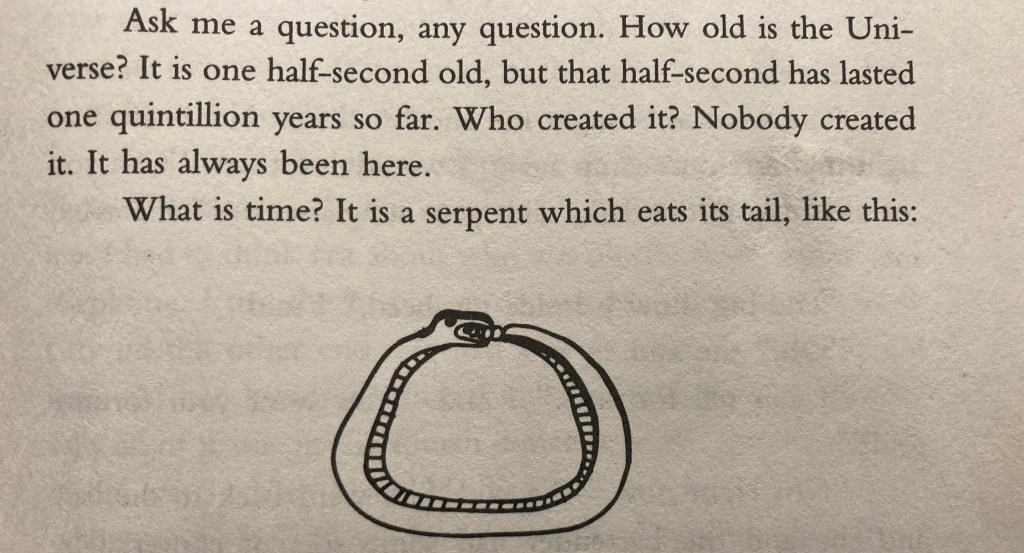
We read the very last verses of Devarim, or Deuteronomy, where Moses dies and it is proclaimed that there will never be another prophet as great as him, and we immediately launch into Bereshit, or Genesis, where Creation begins again with the separation of light and dark, day and night. We are always in a state of becoming. Endings and new beginnings do not unfold all at once. And endings and new beginnings are one in the same.
So, I got to chant these last verses of Devarim and these first verses of Bereshit. This alone is an extra cool piece of Torah to have for your first aliyah*! And I’m here to tell you the extra layers of why it was significant for me.
Three years ago on Simchat Torah, I was still in the process of converting. To be clear, I believe I have always been Jewish, but that, for reasons I still don’t quite understand, g-d felt the need to make me learn and then unlearn Protestant prudishness and a self-destructive work ethic. This is a story for another time. For our story today, it’s important to know that three years ago I was yearning to hold that Torah but couldn’t!! I was so envious of the people holding her and dancing with her!
Some time in the following spring, I finally, technically, completed all the steps of conversion. Every part of it was not quite right, though. I say “some time” because I don’t actually remember what day it happened. I wanted to pick some special or memorable date for my beit din** and mikveh*** and welcoming to the community, but that didn’t pan out.
In my beit din, when three rabbis from the local community asked me about my journey to Judaism and what kind of Jew I wanted to be, they asked me what issues I have with Judaism. I gave my practiced, carefully worded answer about Zionism. I was still afraid that if I was too honest about Palestine, they would deny me, but I also had to be honest that my biggest struggle was that every mainstream Jewish institution is ardently Zionist, unwaveringly supportive of a violent ethnostate and occupation, even when they’re allegedly progressive.
I could cope with the fact that fundamentalists would never think I count. I could even cope with the queerphobia and the patriarchal practices that permeate a lot of Jewish spaces, though maybe I shouldn’t. But I couldn’t quite cope with tacit, seemingly unquestionable support for slow, deliberate ethnic cleansing, so, I had to say so, even though it made me nervous.
They didn’t deny me, in this instance, and I had my mikvah. The cantor**** I’d been meeting with told me to take my time, and so I did. What he actually meant, it turns out, was, “Hurry up, we have other places to be.”
And so this pivotal moment in my spiritual life was rushed, and clouded over by Zionism, as so much of Jewish life is.
I thought I would get to appear before the congregation at our synagogue, maybe give a speech, maybe explain the name I’d carefully chosen for myself, definitely receive a blessing, and be witnessed in this confirmation of what I had known about myself for many years.
There was no appearance before the congregation. There was no witnessing beyond one Shehechiyanu***** from my beit din rabbis and the pride of my soon-to-be wife and a few friends I told about it.
When the cycle of the year rolled back around to fall, Simchat Torah came again.
I was getting married in a week. You’re supposed to receive a blessing on the Shabbos before your wedding. None of our clergy had offered this to us, despite being the ones who would be officiating our wedding. I asked that afternoon, “Could we please squeeze this in? It’s important to us.”
This was the first time either of us appeared before the members of our synagogue we’d been attending for years. The first time many of them knew we existed. We received our blessing, we helped unroll the Torah, we heard the ending and beginning chanted. We went outside to celebrate.
This time, I was so excited. I was going to hold the Torah and I was going to dance with her!! The moment came. Someone handed her off to me. I started to dance. I was so happy!! And then, a clergy member came up to me in a panic and took her from me. The celebration continued. Others held her and danced wildly with her. And so this pivotal moment in my spiritual life was cut short. I was left confused and hurt. It seemed they did not trust me with her.
This was the last time we ever set foot in that synagogue, ever celebrated with those people.
That day was October 7, 2023, in the Gregorian calendar. I found out the next day that something was happening in Palestine.
Yesterday was the Hebrew calendar’s anniversary of that day.
Yesterday was also the Gregorian calendar’s anniversary of the day I got married to my wonderful wife.
In our wedding ceremony, we did what any responsible Jews would do: we radically changed traditional wedding rituals to reflect our non-hierarchical, non-patriarchal, queer diasporist values.
To give my favorite example, we replaced the breaking of the glass with the breaking of pinecones and acorns and buckeyes. Breaking the glass traditionally holds sorrow at the destruction of the First and Second Temples. We’re supposed to grieve this every chance we get and yearn for the Temple to be rebuilt, but my wife and I don’t. The destruction of the Temple, the end of a place-based Judaism, is the creation of Rabbinic Judaism, the beginning of the Diaspora being the only choice. We believe that the Diaspora is what has kept Judaism resilient and creative for all these thousands of years. And so we broke these seeds of Here, the land that has fed us, so that they could grow into something new, beautiful, resilient.
Within weeks of the wedding, it became clear our clergy we had worked so closely with for years had lied to us about how much space they could hold in their hearts for Palestine and its people.
We watched as collective punishment unfolded in Gaza. We watched the existing Israeli control of the flow of resources into Gaza become a complete blockade. We watched bombs falling indiscriminately. We watched targeted drone strikes. We watched a hospital under siege for the first of several times. We saw carnage and rubble and tears. Even in that first month, it was already too much to bear, even as mere witnesses.
We confronted our entire clergy team. We asked if they’d call for a ceasefire, speak of Palestinian suffering, actively support anti-Zionist members, show literally any gesture towards a just position. We appealed to their values, to their logic, to their empathy. Somehow, they were not seeing the same reality. We received the usual defensive talking points from the head rabbi, talking points we would hear over and over again for years to come from many, many more people. We received silence from the people we’d started to think of as friends, the people who had only just officiated our wedding.
And so we did what any responsible Jews would do: we left that synagogue. We felt immense grief and anger and frustration and betrayal and rejection. I finally admitted to myself how little genuine care I had felt from them, how used I felt. I finally admitted how much I had already compromised my own values for the sake of having a Jewish community, and that I couldn’t do it anymore. We didn’t know where we were going next, but we couldn’t be there anymore.
Within weeks, we were trying out a new shul, and we were starting to organize with other Jews for an end to the destruction of Gaza and its people, for the beginning of a liberated and whole Palestine. A lot of other Jews were doing the same thing. The ending is the beginning.
Though it seemed impossible two years ago, we have watched the depravity of the state of Israel reach new extremes. We have witnessed atrocity beyond comprehension.
And we have witnessed too many of our fellow Jews doubling, tripling, quadrupling down on their support for the state of Israel. My friends and I have had our Jewishness questioned ad nauseum, have been called horrible things by other Jews, have over and over again lost respect for people with whom we thought we shared values. A few loved ones aren’t so sure they want to be Jewish anymore at all. The cracks are becoming a gaping schism.
For my part, I’ve doubled down on building a Jewish practice that is anti-Zionist and diasporist and pro-Palestine and pro-everyone’s-liberation and anarchist and queer and neurodivergent and Appalachian and disabled. I could only do this with the help of people who actually trust me with this tradition, who believe I can help to carry it into a better version of itself. I could only do this through trust in my self, in my ability to carry me into a better version of myself, and help the world along into a better version of itself, too.
In the process of learning how to chant the Torah, I consciously decided to let myself do it imperfectly, to give up a desire to do it The Best Anyone’s Ever Done It, to not self-sabotage before I even started. This was the hardest part for me. I learned what I needed to in order to acquire the skill, and I asked for lots of help, and I offered gratitude in return, and will probably offer more gratitude in the future. I practiced so much, and I learned it nearly by heart.
When the moment came, I didn’t do it perfectly. And I kept going, and I found the rhythm again, and I finished what I started. For maybe the first time in my life, I didn’t do something perfectly and didn’t beat myself up for it. I feel, in my surrender to imperfection, that I’m becoming more of someone accountable for themself. I’ve tried for years now to choose to do what a responsible Jew would do, what a responsible adult would do, and this feels like a new beginning in that journey. To have the Big Thing go imperfectly, and to keep rolling along, to stay proud of my hard work, to know that this is simply part of life. This is part of what it is to be accountable, right? To accept imperfection?
In the leadup, I talked to friends about how nervous I was, and they usually had a story to tell about fucking it up in one way or another, and that was beautiful. Absolutely everyone was so excited for me, and that meant so much. I think I’ve hit all the milestones for now. Maybe next time I chant the Torah it will go more smoothly. But I know it will be okay if it doesn’t. We’re always in a state of becoming. Endings and beginnings don’t happen all at once.
After we rolled the Torah back up, we danced with her. I held her for a long time. I felt the physical weight of her, and also the weight of all my personal history, and the weight of all the collective history there is to be weighed down by. I held her like an ancient ancestor, and also like a baby. All the endings and all the beginnings. All the grief and all the joy.
G-d willing, us willing, we are in the midst of the end of a Judaism intertwined with Zionism and empire and capitalism and exclusion. G-d willing, us willing, we are in the midst of the beginning of a Judaism rooted in the liberation of all people and the earth.
G-d willing, us willing, we will see a new, liberated Palestine rise from the rubble of the old. We will see her wounds heal, her children flourish, her olive groves thrive, her knowledge and culture blossom once again.
G-d willing, us willing, we, all of us, embrace the collapse of empire and capital as an opportunity to build something new, beautiful, and resilient.
The ending is the beginning.
Ken yehi ratzon.******
* Aliyah literally means ‘ascent.’ It refers to being called up to the Torah to receive blessings and be with the Torah while it is read, if not reading it yourself. Aliyah also refers to immigrating to Israel, though. The cantor I worked with asked me if I’d ever go on Birthright or ‘make aliyah’ (move to Israel) and never asked me if I wanted to go up the Torah or learn to read it or anything. I can’t even be articulate about how fucked that is. Anyways…
** A beit din is a rabbinic court. In Reform Judaism, a beit din is only called for conversions, and from what I understand they kind of never turn down a conversion candidate. In other communities, a beit din might oversee anything to which halakha, or Jewish religious law, can apply. In Orthodox communities, people might go to a beit din to have civil matters resolved instead of a political court.
*** A mikveh is a bath for ritual immersion, or the ritual immersion itself. There is a lot of stuff about mikvot!! What you need to know for this is that people visit a mikvah before/during big life transitions, like converting or getting married, both of which I’ve been to the mikvah for. And I love the teaching that the water of the mikvah cleanses us by softening our edges so that we can take on a slightly new shape when they firm up again. And the teaching when we are fully immersed in the water, we return momentarily to the beginning of Creation. Like I said, there is a lot about the mikveh. Maybe I’ll write about this another time. I don’t know.
**** A cantor is a member of the clergy who is particularly well-versed (ha ha) in Jewish liturgy.
***** The Shehechiyanu is a prayer to celebrate new things and to thank g-d for bringing us to this moment.
****** “Ken yehi ratzon” means “May it be so.”
 Lou Hughesele
Leave a comment