
NoodiMag Volume 4
Welcome to NoodiMag, the container for all my noodling on noodles, pastas, and all related topics.
Pasta Shapes Consumed: Pierogy; Gemelli; Lasagne (no ruffled edges); Miniature Shells; Round Ravioli; Fettucine
Total Pasta Shapes To Date: 14
The Appetizer:
I feel as though I am stagnating in the quest to have as many pastas and noodles as possible. My most loyal readers will notice a lot of repetition, and only a few new shapes each fortnight. I can’t quite tell if 14 varieties in six weeks is a lot. It’s probably more than average. Is it a sustainable rate if I’m to keep this up all year? Also hard to tell. In the most romantic part of my heart, I want each pasta dish I eat to be a new type, but this is not the reality of groceries and cooking in the world as it is. In the most neurotic part of my heart I want to get through every type by the end of the year, but there are hundreds upon hundreds, and I do actually like to eat other foods. As mentioned in Volume 2, I have to remind myself that this is not a goal of rigidity and endurance, but of pleasure and experience.
The real goal, I think, is a deeper appreciation for the craft and for the subtle changes that make a big difference. For instance, this week I’ve eaten both pierogy and ravioli. You could argue that these are more or less the same thing with different fillings, and you would be wrong. In comparing these two dishes, I can appreciate just how much the method of sealing the dumpling alters the experience. I also have been reading about how much the type and quality of wheat used can alter the texture, and I’m fairly certain these two products use different wheats, despite both simply listing “wheat flour” as an ingredient. These are things I’ll be looking out for as I continue this journey.
I’m starting to get caught up in the intellectual side of things. Maybe it’s all the Aquarian energy lately. I’ve learned just enough in my research that it’s all very exciting, and a little overwhelming, and it’s hard to stay focused. There’s so many ideas and connections and inspirations, it’s difficult not to just end up hollering incoherently about it until I wear myself out. Just as with the embodied side, this is an exercise in pacing myself. Welcome to my attempt to shift my hyperfixation process. Here’s a taste of what I’ve been learning…
The Entree:
After last issue’s ponderings on pad Thai noodles, known in Thai as Kuai tiao (ก๋วยเตี๋ยว) and based on a noodle of Chinese origin transliterated as guotiao and also called shahe fen (“fen” being the Mandarin for noodles made of starches besides wheat), I began to really wonder in earnest about our terminology, its etymologies, what is being communicated by using one term over another, whether we could be using the Italian term “pasta” and the Mandarin term “mian” interchangeably, as they both mean “noodles made with wheat.” At the start of these particular ponderings, I was operating under the impression that all preparations of ground wheat, water, salt, and maybe egg formed into various shapes originated in China and were brought to Europe by Marco Polo in 1295. I found, though, that this is a myth created by advertisers in 1929 and resented by Italians. The story was first published in Macaroni Journal, the trade magazine of the National Pasta Association (formerly the National Macaroni Manufacturer’s Association), which went out of print in 1984 and the haphazard archival scans of which I have been reading and immensely enjoying. (Expect more on this window into a niche community at a later date.)
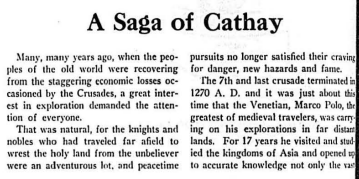
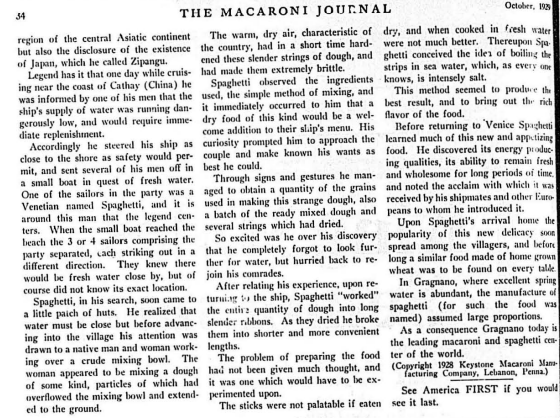
Instead, the true origins of pasta, mian, and other similar foods are murky, ancient, and completely independent of one another. It appears that wherever wheat is grown, humans have ground its fruit, combined it with water, and shaped it into something delightful. The oldest known archaeological evidence of noodles was found in a 4,000 year old ceramic bowl excavated in Qinhai, China. References to pastas and noodles are found in surviving texts from Ancient Rome and Greece, including a Greek myth wherein the muse Thalia inspires Macareo to build an extruder and make pasta for poets. In the 9th Century AD, Arab-Spanish entertainers sang songs extolling the virtues and elegance of noodles. There are many more examples. I could very easily get lost in the sauce, so to speak, on the ancient tradition of loving pasta and noodles, and I will over time. The point I mean to make here today is that the communities around the Mediterranean Basin already had many, many variations on what we now call pasta by the time Marco Polo made his expeditions to China.
What actually happened when Marco Polo ventured to China is this: he saw their noodles and he wrote in his travel log whatever the Medieval Italian equivalent is of, “Holy shit, they have lagane here, too!!!” At the time, “lagane” was a common term in Europe for everything that we might call pasta or noodles today. This comes from the Greek “laganon,” referring to strips of dough made of flour and water, and would become “lasagne.” “Macaroni” was also in use around this time, as well as a number of other terms in local languages and dialects.
Later, in the Renaissance period, when it became more common to purchase dried pasta in the market than make it at home, it was all called “vermicelli.” In the 18th and 19th Centuries, which saw the unification of Italy, mass migration from Italy to the United States, and the dawn of mass manufacturing as never seen before, it all came to be known as “macaroni.” It is only very recently– as in only since the mid-20th Century– that “pasta” has become the common term for all of these culinary preparations. In Italy, the legal term is “paste alimentari,” while in the United States, our regulations around these products are largely from the early 20th Century, and so still refer to “macaroni products.” I’m still learning how and why all these language shifts happened, but the growing uniformity across some geography and not others has much to do with imperialism, nationalism, and globalization, and we will continue to dig into all of that.
The Dessert:
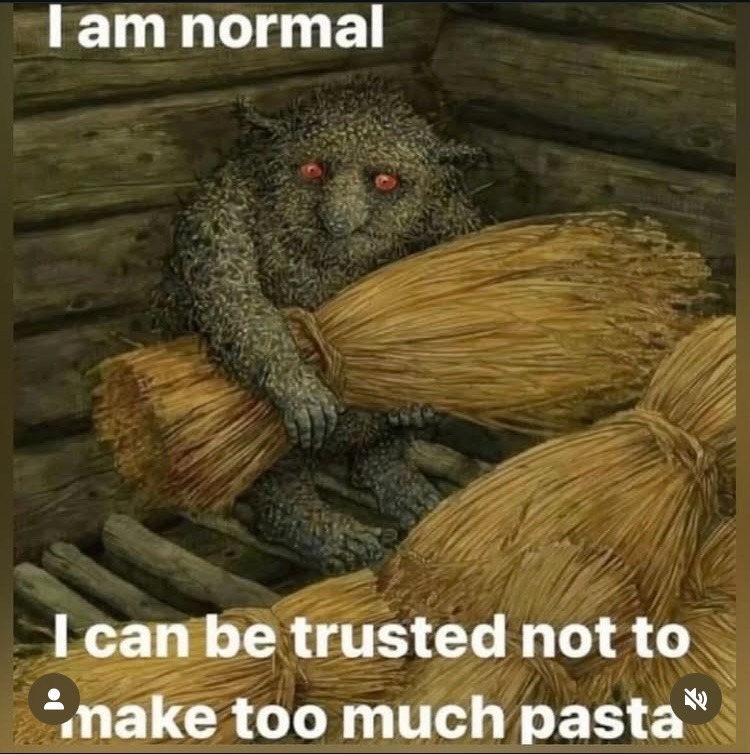
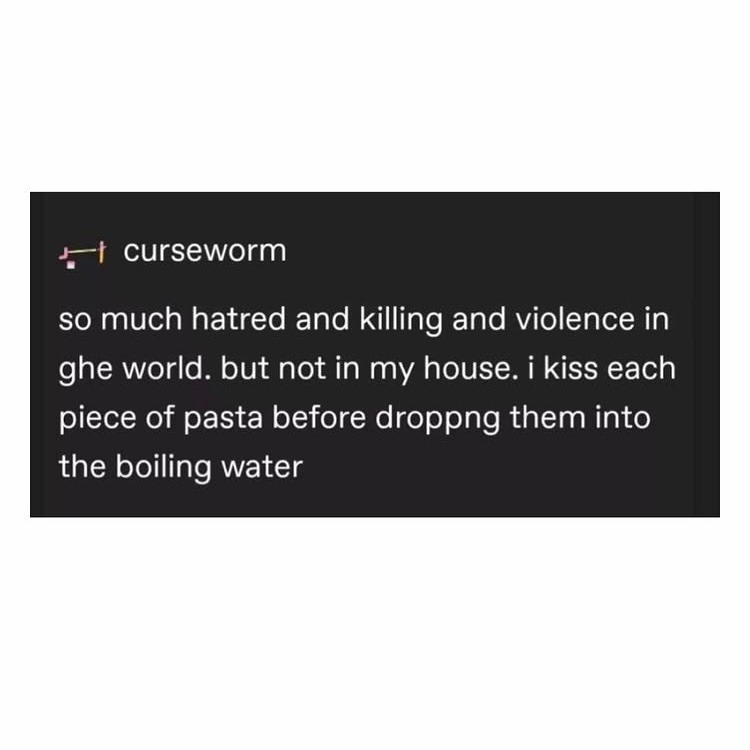
I’ll leave you with memes today…
Thanks for reading! Maybe next time will be better.
Works Cited:
Montanari, M. (2021). A Short History of Spaghetti with Tomato Sauce: The Unbelievable True Story of the World’s Most Beloved Dish. (G. Conti, Trans.) Europa Editions.
Shelke, K. (2016). Pasta and Noodles: A Global History. Reaktion Books Ltd.

 Lou Hughesele
Leave a reply to limburgeralmostae654dcd9c Cancel reply